
Language becomes more powerful when it can copy real-life sounds through words. This special type of word is called onomatopoeia, and onomatopoeia examples are words that imitate actual sounds we hear in daily life. These sounds can come from animals, people, objects, or nature. For example, words like buzz, beep, clang, and meow are not just normal vocabulary words; they actually sound like what they describe. This makes it easier for readers to understand and imagine the situation clearly. Instead of only saying “the bee is flying,” we can say “the bee is buzzing,” which gives a stronger and more realistic feeling.
These onomatopoeia examples are widely used in stories, poems, comics, and even everyday conversations because they make language more lively and expressive. Writers use them to create a strong visual and emotional impact on the reader. For example, “The door went creak” immediately helps you imagine the sound of an old door opening. Similarly, “The clock goes tick-tock” helps you hear the sound in your mind. Learning and using these sound words can improve your English writing, make your stories more interesting, and help you express ideas more clearly and creatively.
What is Onomatopoeia?
Onomatopoeia is a very interesting part of the English language where words are formed to imitate real-life sounds. In simple terms, it means that the word itself sounds like the noise it describes. For example, words like buzz, bang, meow, and tick-tock are called onomatopoeia because they copy the actual sound we hear in real life. These words help readers and listeners easily understand and imagine the sound without needing extra explanation. This is why onomatopoeia examples are commonly used in everyday English.
Simple Definition of Onomatopoeia
Onomatopoeia is a type of word that copies real sounds from the world around us. It means the word itself sounds like the noise it describes. These sounds can come from animals, objects, nature, or machines. For example, when a bee makes a sound, we say “buzz,” and when a clock works, we say “tick-tock.” These are simple onomatopoeia examples because the words imitate the real sounds we hear in daily life. This makes English easier to understand because the reader can quickly imagine the sound just by reading the word.
These onomatopoeia examples are very useful in writing, speaking, and storytelling. Writers use them to make sentences more interesting and realistic. For example, instead of saying “the door made a sound,” we can say “the door went creak,” which gives a clearer picture in the reader’s mind. Similarly, words like “bang,” “buzz,” “meow,” and “crash” help create strong visual and sound effects in stories and poems. Learning these sound words improves vocabulary, makes writing more creative, and helps in better communication in English.
Why Onomatopoeia is Used in English
Onomatopoeia is used to make language more expressive, clear, and interesting. Instead of explaining a sound in a long sentence, a single word can quickly show what is happening. This helps the reader easily understand the situation and imagine the real sound in their mind. For example, saying “The door went creak” is much more powerful than simply saying “The door made a sound.” The word creak directly gives the feeling of an old door opening slowly.
Writers often use onomatopoeia examples in stories, poems, comics, and even children’s books to make scenes more lively and realistic. Words like buzz, bang, crash, and tick-tock add sound effects to writing, making it more engaging for readers. Instead of plain description, these sound words create a strong picture in the reader’s imagination and make the writing more enjoyable and easier to connect with.
Importance of Writing and Communication
Onomatopoeia plays an important role in writing and communication because it makes language more lively, emotional, and interesting. Instead of plain sentences, it adds sound-based words that help the reader feel what is happening. This means readers can “hear” the action in their mind while reading, which makes the message easier to understand and more engaging. For example, words like buzz, crash, and tick-tock can quickly bring a scene to life without needing long explanations.
In storytelling, onomatopoeia examples improve creativity by making descriptions more powerful and realistic. They help writers show actions more clearly and expressively, especially in stories, poems, and comics. Learning these sound words also helps students build a stronger vocabulary, improve their writing skills, and express their ideas more clearly in English. Over time, using onomatopoeia makes communication more natural, creative, and effective.
Basic onomatopoeia examples in Everyday Life
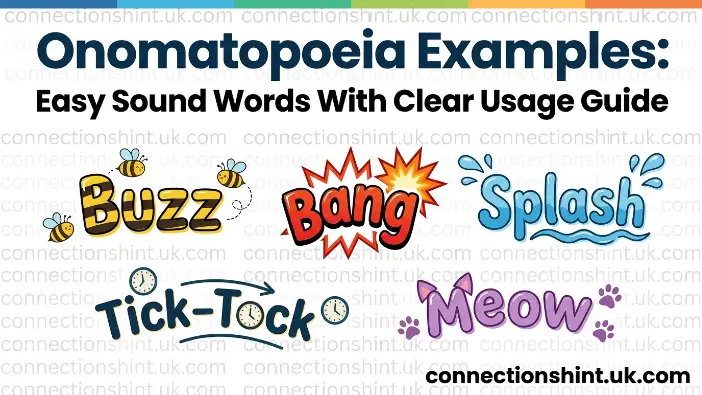
Every day life is full of sounds, and many of these sounds are represented through special words called onomatopoeia. These onomatopoeia examples help us describe real noises simply and naturally. We use them in speaking, writing, and even storytelling without realizing it. From morning alarms to night-time silence, sound words are everywhere around us.
Common Daily Sound Words
In daily life, we hear many simple sounds that can be described using onomatopoeia. These words are short, easy to understand, and commonly used in English. They help us express real-life noises clearly and naturally without needing long explanations. Some common onomatopoeia examples include buzz (sound of insects or vibration), beep (short electronic sound), bang (loud impact), pop (small explosion or burst sound), and click (small sharp sound).
These words make communication faster and more effective because they immediately show what kind of sound is happening. Instead of describing the sound in detail, we can use a single word that everyone easily understands. This is why onomatopoeia examples are very useful in both spoken and written English.
Household Sound Examples
Inside the home, many sounds happen all the time, and these can be easily described using onomatopoeia. Onomatopoeia helps us turn real-life noises into simple words so we can express them clearly in English. Some common home-related onomatopoeia examples include tick-tock (sound of a clock), drip (water drops falling), creak (sound of a door or floor), ding-dong (doorbell ringing), and clap (sound of hands hitting together).
These onomatopoeia examples make it much easier to describe daily home activities realistically and understandably. Instead of explaining a sound in a long sentence, a single word can quickly show what is happening. This makes writing more natural, expressive, and easy for the reader to imagine.
Technology Sound Words
Modern life is full of electronic devices, and almost all of them produce different types of sounds. These sounds are also described using onomatopoeia, which turns real noises into simple and easy-to-understand words. Instead of explaining the sound in a long sentence, we use short sound words that quickly show what is happening. Some common technology-related onomatopoeia examples include beep (phone or machine alert), ping (notification sound), buzz (vibration alert), whirr (sound of a running machine), and click (sound of a mouse or keyboard).
These onomatopoeia examples are widely used in digital communication, everyday conversations, and even in writing about modern life. They help describe technological sounds clearly and naturally so that the reader can easily imagine them. Instead of saying “the phone made a notification sound,” we can simply say “the phone went beep,” which is shorter, clearer, and more expressive.
Sentence Usage of Onomatopoeia
Using onomatopoeia in sentences makes writing more lively, realistic, and easy to imagine. These onomatopoeia examples help describe actions and sounds simply and powerfully. Instead of using long explanations, a single sound word can quickly show what is happening in a clear and natural form. For example, words like buzz, crash, beep, and click immediately give the reader a mental picture of the sound. Because of this, onomatopoeia is very useful in everyday writing, storytelling, and even communication.
Simple Sentences
Simple sentences using onomatopoeia are very helpful for beginners because they make English easy to understand and more interesting. These onomatopoeia examples use sound words like buzz, beep, creak, and honk to show real-life actions. Simply explaining a sound in many words, a single word is enough to describe what is happening. For example, “The bee went buzzing around the flowers” clearly shows the sound and action at the same time. This helps learners quickly understand both meaning and usage.
These onomatopoeia examples also make sentences more lively and realistic. When we say “The door made a creak when it opened” or “The alarm clock went beep in the morning,” the reader can easily imagine the exact sound in their mind. This makes writing more engaging and easier to remember. Using such simple sound words improves vocabulary, strengthens sentence building, and helps students express ideas more clearly in English.
Creative Writing Examples
In creative writing, onomatopoeia is used to make descriptions more interesting, powerful, and expressive. Instead of only telling the reader what is happening, these sound words help them feel and “hear” the action in their imagination. This makes stories and descriptions more engaging and realistic. These onomatopoeia examples are especially useful in storytelling because they create strong visual and sound effects at the same time.
For example, sentences like “The thunder went boom, shaking the whole sky” or “The wind went whoosh through the empty street” help the reader instantly imagine the sound and movement. Similarly, “The glass crashed onto the floor in pieces” and “The old floorboards creaked as he walked slowly” add emotion and intensity to the scene. These onomatopoeia examples allow writers to build strong mental images, making the writing more vivid, creative, and memorable for the reader.
Poetry and Story Use
Poets and storytellers use onomatopoeia to make their writing more emotional, rhythmic, and engaging. These sound words help create a musical flow in sentences and allow readers to experience the scene more deeply. Blog instead of only describing an event, writers can also “show” the sound, which makes the writing feel more alive and expressive. These onomatopoeia examples are especially powerful in poetry because they add rhythm and emotion at the same time.
For example, lines like “The rain went drip-drip on the roof all night long” or “The clock goes tick-tock, counting every moment” help create a steady rhythm in the poem. Similarly, “The lion gave a roar in the silent jungle” and “The fire goes crackle in the cold night” add strong emotional and visual impact. These onomatopoeia examples make poems and stories more musical, vivid, and enjoyable for readers by turning simple descriptions into sensory experiences.
Benefits of Learning Onomatopoeia
Learning onomatopoeia is very helpful for improving English skills because it makes language more expressive, creative, and easy to understand. These onomatopoeia examples allow learners to describe real-life sounds simply and effectively, which improves both writing and speaking ability.
Improves Writing Skills
Learning onomatopoeia improves writing skills by helping students use more vivid and descriptive words. Instead of writing long explanations, they can use sound words like buzz, crash, or beep to make sentences clearer and more powerful. These onomatopoeia examples help writers create stronger images in the reader’s mind and improve overall sentence quality.
- Learning onomatopoeia improves writing skills by helping students use vivid and descriptive words.
- Instead of long explanations, they can use simple sound words like buzz, crash, or beep.
- These onomatopoeia examples make sentences clearer, stronger, and more effective.
- They help create strong visual images in the reader’s mind.
- Writing becomes more interesting, creative, and easy to understand.
- Students can avoid boring or repeated words by using sound words.
- Regular practice improves vocabulary and overall sentence quality.
- It also helps in developing a more natural and engaging writing style.
Makes Stories More Interesting
Onomatopoeia makes stories more exciting and engaging. When writers use sound words, readers can “hear” the action while reading. For example, words like bang, whoosh, and tick-tock make stories feel real and lively. These onomatopoeia examples help turn simple stories into interesting and memorable experiences.
Onomatopoeia makes stories more exciting and engaging for readers.
- It helps readers “hear” the action while reading the text.
- Sound words like bang, whoosh, and tick-tock make scenes more realistic.
- These onomatopoeia examples bring life and movement into simple storytelling.
- They turn ordinary descriptions into lively and interesting experiences.
- Readers can easily imagine what is happening in the story.
- It makes stories more memorable and enjoyable to read.
Helps in Exams and Communication
Onomatopoeia is also useful in exams and daily communication. Students can use sound words in essays and creative writing to gain better marks. It also helps in speaking English more naturally. These onomatopoeia examples make it easier to express ideas clearly, especially when describing actions or events.
- Onomatopoeia is very useful in exams and daily communication.
- Students can use sound words in essays and creative writing to score better marks.
- It improves English speaking by making expressions more natural and fluent.
- These onomatopoeia examples help in describing actions and events clearly.
- Sound words make it easier to explain situations in a simple way.
- They improve both written and spoken communication skills.
- Using them correctly makes answers more creative and effective in exams.
Common Mistakes Students Make
Learning onomatopoeia is very useful, but many students make small mistakes while using it. Understanding these mistakes helps improve writing and makes onomatopoeia examples more effecti,v e awhennen students recognize these errors, they can use sound words more accurately and confidently. This also improves clarity in writing and helps avoid confusion for the reader. Practicing onomatopoeia examples in the right context gradually builds stronger grammar, better vocabulary, and more natural expression in English.
Confusing Sound Words
One common mistake is mixing similar-sounding words. For example, students may confuse buzz with beep or crash with bang. Each word represents a different type of sound, so using the wrong one can change the meaning of the sentence. A correct understanding of onomatopoeia examples is important for clear communication.
- One common mistake is confusing similar-sounding words.
- Students often mix up words like buzz and beep, or crash and bang.
- Each sound word has a different meaning and represents a different type of noise.
- Using the wrong word can change the meaning of the sentence.
- A correct understanding of onomatopoeia examples is important for clear communication.
- Learning the difference helps students use sound words accurately.
- It improves writing clarity and avoids confusion for the reader.
- Regular practice helps build a stronger vocabulary and better usage skills.
Overusing Onomatopoeia
Another mistake is using too many sound words in one sentence or paragraph. While onomatopoeia makes writing interesting, too much of it can make the text confusing or unnatural. Good writing uses onomatopoeia examples in a balanced way to keep the story clear and enjoyable.
- Another common mistake is using too many sound words in one sentence or paragraph.
- While onomatopoeia makes writing more interesting, overusing it can make the text confusing.
- Too many sound effects can also make writing feel unnatural or messy.
- Good writing uses onomatopoeia examples in a balanced and careful way.
- This helps keep the story clear, smooth, and easy to understand.
- Proper use makes the writing more enjoyable for the reader.
- Balance is important to maintain quality and readability in sentences.
Incorrect Context Usage
Students also sometimes use sound words in the wrong situation. For example, using buzz for a door or creak for a phone is incorrect. Each word has a specific meaning, so it must match the right object or action. Proper use of onomatopoeia examples ensures writing stays accurate and meaningful.
- Students sometimes use sound words in the wrong situation.
- For example, using buzz for a door or creak for a phone is incorrect.
- Each sound word has a specific meaning and represents a specific type of noise.
- It is important to match the sound word with the correct object or action.
- Proper use of onomatopoeia examples makes writing accurate and meaningful.
- Correct usage helps the reader clearly understand the situation.
- It also improves the quality and clarity of English writing.
Frequently Asked Questions
What is onomatopoeia in simple words?
Onomatopoeia is a word that sounds like the real noise it describes. For example, buzz, beep, and bang are simple onomatopoeia examples because they imitate real-life sounds.
Why do we use onomatopoeia in writing?
We use onomatopoeia to make writing clearer, more expressive, and more interesting. It helps readers imagine and “hear” the action while reading.
Where is onomatopoeia commonly used?
Onomatopoeia is commonly used in stories, poems, comics, advertisements, and everyday conversations to make language more lively.
Can onomatopoeia improve English skills?
Yes, learning onomatopoeia examples improves vocabulary, writing skills, and creativity. It also helps students express ideas more naturally in English.
What are some easy examples of onomatopoeia?
Some easy examples include buzz, meow, crash, tick-tock, whoosh, and beep.
Conclusion
Onomatopoeia is a powerful part of the English language that makes writing more expressive, creative, and easy to understand. These onomatopoeia examples help simply describe real-life sounds, making stories, poems, and sentences more lively and engaging.
By using sound words like buzz, crash, beep, and tick-tock, writers can create clear mental images and help readers “hear” the action in their mind. Learning onomatopoeia examples not only improves vocabulary and writing skills but also strengthens communication in both exams and daily life. With regular practice, anyone can use these sound words correctly and make their English more natural and effective.