
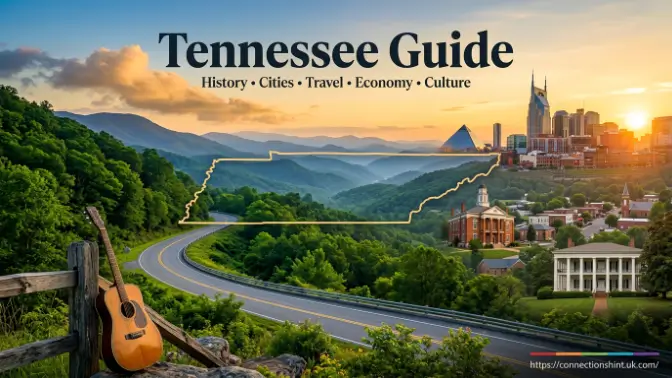
Welcome to connectionshint. Tennessee, commonly searched as tennesee, is a southeastern state in the United States that offers a rich mix of history, culture, and natural beauty. It is surrounded by mountains, valleys, rivers, and forests, which makes it one of the most scenic places in the country. The state has both large, busy cities and quiet rural areas, giving people the choice between a modern lifestyle and a peaceful country life. This balance is one of the reasons why many people enjoy living in or visiting Tennessee.
This state is especially famous for its strong connection to American music history. Cities like Nashville and Memphis played a major role in the development of country music, blues, and early rock and roll, which influenced music around the world. Because of this musical heritage, millions of tourists visit every year to explore live music shows, museums, and cultural festivals. Tennessee is also known for its warm Southern hospitality, delicious food such as BBQ and Nashville hot chicken, and its important role in American history, which helped shape the country into what it is today.
Geography and Location of Tennessee
Tennessee is located in the southeastern region of the United States and is known for its diverse physical landscape. Even though it is a landlocked state, it has many natural features such as mountains, rivers, forests, and flat plains. This combination of landforms makes Tennessee suitable for farming, tourism, transportation, and city development. The state acts as a bridge between different parts of the USA, connecting the South, Midwest, and the Appalachian regions.
Where is Tennessee located?
Tennessee is positioned in a central area of the southeastern United States. It stretches from the Appalachian Mountains in the east to the Mississippi River in the west. This wide geographical spread gives the state different natural environments in a single region.
The eastern side is mountainous and cooler, while the western side is flatter and warmer. Because of this variation, people living in different parts of Tennessee experience different climates and lifestyles. The state’s location also makes it an important travel and transportation route, connecting major highways and cities across neighboring states.
Neighboring states and regions
Tennessee shares borders with eight states, which makes it one of the most centrally connected states in the USA. It touches Kentucky and Virginia in the north, North Carolina in the east, Georgia, Alabama, and Mississippi in the south, and Arkansas and Missouri in the west.
This large number of neighboring states helps Tennessee maintain strong cultural and economic connections. People frequently travel across these borders for work, education, and tourism. As a result, Tennessee has a rich mix of Southern traditions, Appalachian culture, and Midwestern influence, making it culturally diverse and socially dynamic.
Climate and weather conditions
Tennessee has a humid subtropical climate, which means it experiences four distinct seasons with generally warm weather. Summers are usually hot and humid, especially in lowland cities like Nashville and Memphis. Winters are mild in most areas, but higher elevations in the Appalachian region can receive snow and colder temperatures.
Rainfall is spread fairly evenly throughout the year, which helps support Tennessee’s forests, rivers, and agriculture. Spring brings blooming flowers and pleasant temperatures, while autumn is known for colorful leaves and cooler air. Because of this seasonal variety, Tennessee is a popular destination for both outdoor recreation and city tourism throughout the year.
Read also: What Does Innovative Mean? Complete Guide to Innovation and Success
History of Tennessee
Tennessee has a deep and complex history that spans thousands of years. It developed from early Native American civilizations into a key region in American expansion, and later became an important part of the United States political, cultural, and economic growth. Each historical stage shaped the identity of Tennessee as we know it today.
Early Native American settlements
Long before European settlers arrived, Tennessee was home to advanced Native American societies. The most influential groups were the Cherokee, Chickasaw, Creek, and Shawnee tribes. These communities lived across different regions depending on the land and climate.
They built stable villages near rivers such as the Tennessee River and the Mississippi River because water was essential for farming, transportation, and daily life. They practiced agriculture by growing crops like corn, beans, and squash, often called the “Three Sisters.” Hunting deer, turkey, and other animals also played a major role in their survival. These tribes had strong cultural traditions, languages, and political systems, showing that the region was already well-organized long before modern history began.
Colonial and state formation
In the 1700s, European explorers and settlers began moving into the region that is now Tennessee. At first, it was part of North Carolina’s western frontier. As more settlers arrived, tensions grew between Native American tribes and colonists due to land disputes and expansion.
Over time, settlers formed the “State of Franklin,” an early attempt to create a separate state, but it did not succeed. Eventually, the land officially became the Southwest Territory under U.S. control. In 1796, Tennessee was admitted to the Union as the 16th state. It earned the nickname Volunteer State because many of its citizens volunteered to fight in the War of 1812, showing strong military support for the young United States.
Civil War significance
Tennessee played one of the most complicated roles during the American Civil War. Because of its geographic position and divided population, the state was split between loyalty to the Union and the Confederacy. East Tennessee largely supported the Union, while Middle and West Tennessee leaned toward the Confederacy. This internal division led to families and communities being torn apart.
Tennessee was also strategically important because of its rivers and railroads, which were crucial for transporting troops and supplies. Major battles such as the Battle of Shiloh and the Battle of Chattanooga took place within the state. Control of Tennessee changed multiple times during the war, making it one of the most heavily contested regions. The war caused major destruction to infrastructure, farms, and cities, deeply affecting the economy and population.
Modern development
After the Civil War, Tennessee entered a long period of rebuilding known as Reconstruction. The economy slowly recovered through agriculture, railroads, and later industrial growth. In the 20th century, Tennessee became a major center for manufacturing, energy, and healthcare research, especially with projects like the Manhattan Project in Oak Ridge during World War II. At the same time, the state became world-famous for its music industry.
Nashville grew into the heart of country music, while Memphis became the birthplace of blues and rock influence through artists like Elvis Presley. Today, Tennessee is a modern and growing state with strong industries in healthcare, logistics, education, tourism, and entertainment. Despite modernization, it still preserves its deep historical identity, blending Native American heritage, Southern traditions, and modern American culture into one unique region.
Major Cities in Tennessee
Tennessee is made up of several important cities that shape its economy, culture, and identity. Each major city has developed in a different way based on its geography, history, and industries. Some cities are famous for music, some for education, and others for technology or trade. Together, they create a balanced and diverse state.
Nashville (Music City)
Nashville is the capital of Tennessee and one of the most influential music cities in the world. It is called “Music City” because it is the global center of country music and a major hub for the recording industry. The city’s growth is strongly linked to the music business. Recording studios, live performance venues, and music publishing companies are concentrated here. Famous landmarks such as the Grand Ole Opry and Ryman Auditorium have shaped American music history for decades.
Nashville attracts musicians from around the world who come to build careers in country, gospel, and modern music genres. Beyond music, Nashville has developed into a strong economic city. Healthcare is one of its biggest industries, along with education, finance, and technology startups. The city has a fast-growing population because of job opportunities and a modern urban lifestyle, combined with cultural richness. It is both a creative hub and a business center.
Memphis (Blues and cultural hub)
Memphis is located in the southwestern corner of the state along the Mississippi River. Its location made it an important trading and transportation center early in history, especially for river-based commerce. Memphis is globally known for its deep musical heritage. It played a major role in the creation of blues, soul, and rock and roll music. Legendary artists like Elvis Presley, B.B. King, and Johnny Cash are closely associated with the city. Graceland, Elvis Presley’s home, is one of the most visited music landmarks in the world.
Economically, Memphis is also a major logistics and shipping hub. Because of its river port, railways, and highways, it serves as a distribution center for goods across the United States. This combination of cultural influence and industrial importance makes Memphis both a historic and modern city.
Knoxville (education and nature)
Knoxville is located in eastern Tennessee and serves as an important educational and cultural center. It is home to the University of Tennessee, which contributes to research, innovation, and a strong student population. Knoxville’s location near the Great Smoky Mountains makes it a gateway for tourism and outdoor activities.
Many visitors pass through the city to reach national parks, hiking trails, and scenic mountain areas. This gives Knoxville a unique identity where education and nature exist side by side. The city has a slower and more relaxed lifestyle compared to Nashville or Memphis. It is known for its community feel, college sports culture, and growing healthcare and service industries. This makes it attractive for families, students, and nature lovers.
Chattanooga (mountains and technology)
Chattanooga is located in southeastern Tennessee, surrounded by mountains, rivers, and valleys. Its geography has shaped both its history and its modern identity. Originally, Chattanooga was an industrial and railway city due to its strategic location. Over time, it transformed into a modern technology and innovation hub. One of its biggest achievements is becoming one of the first cities in the United States to provide city-wide high-speed fiber internet, earning it the nickname “Gig City.”
Today, Chattanooga is known for balancing technology with nature. It has a growing startup ecosystem, a strong manufacturing base, and a thriving tourism industry. Attractions like Lookout Mountain, Ruby Falls, and the Tennessee Riverwalk make it a popular destination for visitors. The city is often seen as a model for how smaller cities can successfully modernize while preserving natural beauty.
Top Tourist Attractions in Tennessee
Tennessee is one of the most visited travel destinations in the United States because it offers a wide range of attractions for all types of travelers. From natural landscapes and mountain views to music history and theme parks, the state provides a rich travel experience. Tourists come here to explore famous landmarks, enjoy outdoor adventures, and learn about American culture and music heritage. The mix of nature and entertainment makes Tennessee a complete vacation destination.
Great Smoky Mountains National Park
The Great Smoky Mountains National Park is the most visited national park in the United States and one of the most important natural attractions in Tennessee. It is known for its fog-covered mountains, dense forests, and rich biodiversity. Blog Visitors can see wildlife such as deer, black bears, and many bird species while enjoying peaceful natural surroundings.
The park offers many outdoor activities like hiking, camping, and scenic driving routes. Trails such as Clingmans Dome provide breathtaking views from the highest points in the region. The Smoky Mountains hiking trails are especially popular for both beginners and experienced hikers because they offer different levels of difficulty and beautiful landscapes throughout the year.
Graceland (Elvis Presley Home)
Graceland is one of the most famous music landmarks in Tennessee and is located in Memphis. It was the home of Elvis Presley, one of the greatest music icons in history. Today, it is open to the public as a museum, attracting millions of visitors every year.
Inside Graceland, tourists can explore Elvis’s personal rooms, his collection of cars, costumes, and awards. The Elvis Presley museum experience helps visitors understand the life and legacy of the “King of Rock and Roll.” It is a must-visit destination for music lovers and anyone interested in American pop culture history.
Dollywood Theme Park
Dollywood is a famous theme park located in the Pigeon Forge area of Tennessee and is co-owned by country music star Dolly Parton. It combines thrilling rides, live entertainment, and cultural experiences inspired by Southern traditions.
The park features roller coasters, water rides, music shows, and craft demonstrations. The Dollywood family entertainment experience is designed for visitors of all ages, making it a popular destination for families. It also hosts seasonal festivals that highlight music, food, and cultural celebrations throughout the year.
National parks and outdoor activities
Tennessee is home to many natural parks and outdoor destinations beyond the Great Smoky Mountains. These include state parks, forests, rivers, and lakes that offer endless opportunities for nature lovers and adventure seekers.
Activities such as camping, fishing, kayaking, and mountain biking are popular across the state. The Tennessee outdoor adventure tourism industry continues to grow as more visitors explore its natural beauty. Whether in forests or river valleys, Tennessee provides peaceful and exciting outdoor experiences for travelers who enjoy nature and fresh air.
Economy and Lifestyle in Tennessee
Tennessee has a balanced and steadily growing economy supported by a mix of traditional industries and modern sectors. The state is known for offering a relatively affordable lifestyle while still providing strong job opportunities in cities and industrial regions. This combination makes Tennessee attractive for both businesses and people looking for long-term settlement. Its economy is not dependent on one sector, which helps it remain stable even when certain industries slow down.
Main industries (music, healthcare, manufacturing)
The economy of Tennessee is built on several key industries that work together to support growth and employment. One of the most unique industries is music and entertainment, which is globally recognized in cities like Nashville and Memphis. This sector includes recording studios, live concerts, publishing companies, and tourism related to music history. It also creates indirect jobs in hospitality, transportation, and retail. Healthcare is one of the largest and fastest-growing industries in the state. Nashville, in particular, is known as a national hub for hospital management companies, healthcare research organizations, and medical services.
This sector provides thousands of high-skilled jobs and contributes significantly to the state’s economy. Manufacturing is another strong pillar of Tennessee’s economy. The state produces automobiles, machinery, chemicals, and food products. Its central location in the southeastern United States makes transportation and logistics easier, allowing manufactured goods to be distributed efficiently across the country. These three sectors—music, healthcare, and manufacturing form the backbone of Tennessee’s economic strength.
Cost of living comparison
Tennessee is widely considered a cost-friendly state compared to many other parts of the United States. Housing is the biggest advantage, as home prices and rent are generally lower than in states like California, New York, or Washington. This makes it easier for middle-income families to buy homes or live comfortably without excessive financial pressure.
Daily living expenses such as groceries, transportation, and utilities are also relatively moderate. However, the cost of living can vary depending on the city. Nashville, due to rapid population growth and high demand, is more expensive than smaller cities or rural areas. In contrast, towns outside major urban centers offer much more affordable living conditions. The Tennessee housing market plays a major role in shaping these differences.
Job opportunities and income levels
The job market in Tennessee is expanding steadily, driven by growth in healthcare, logistics, education, manufacturing, and technology. Large cities like Nashville and Memphis provide the highest concentration of employment opportunities, especially in hospitals, corporate offices, transportation companies, and entertainment industries.
Although average income levels in Tennessee may be slightly lower than in some high-cost states, the lower expenses for housing and daily living help balance overall quality of life. Many people find that their income goes further in Tennessee compared to more expensive regions. The state also continues to attract new companies and investments, which is expected to further improve job availability and wage growth in the future.
Culture, Music, and Food in Tennessee
Tennessee has a rich cultural identity shaped by music, food, and long-standing Southern traditions. The state is known worldwide for its strong influence on American music and its deep-rooted hospitality culture. Life in Tennessee reflects a blend of history, creativity, and community values, where music plays a central role in daily life and food traditions bring people together. This cultural mix makes Tennessee one of the most distinctive states in the United States.
Country music heritage
The country music heritage of Tennessee is one of its most important cultural contributions to the world. Cities like Nashville became the center of country music, where artists record songs, perform live, and build global careers. This industry has influenced not only American music but also international music styles.
The country music tradition in Tennessee is supported by famous institutions like the Grand Ole Opry and the Country Music Hall of Fame. These places preserve the history of legendary artists while also promoting new talent. Music is deeply connected to the identity of the state, and live performances are a common part of everyday life, especially in entertainment districts.
BBQ and Southern cuisine
Food culture in Tennessee is strongly influenced by Southern cooking traditions. One of the most famous dishes is Memphis-style BBQ, known for slow-cooked pork ribs and rich, smoky flavors. Nashville is also famous for its hot chicken, a spicy fried chicken dish that has become popular across the United States.
The Southern cuisine tradition in Tennessee reflects comfort, flavor, and community. Meals often include biscuits, cornbread, fried foods, and slow-cooked meats. Food is not just about eating; it is also a social experience where families and friends gather to share meals, especially during weekends, festivals, and celebrations.
Festivals and traditions
Tennessee hosts many festivals and cultural events throughout the year that celebrate its music, food, and history. The CMA Music Festival in Nashville is one of the biggest country music events in the world, attracting fans from many countries. Memphis also hosts festivals that highlight blues music and cultural heritage.
The festival culture in Tennessee reflects the state’s strong community spirit. Seasonal fairs, cultural parades, and food festivals are common in both cities and small towns. These events help preserve traditions while also supporting tourism and local businesses. Festivals in Tennessee are a key part of how people celebrate identity, creativity, and togetherness.
Travel Tips for Visiting Tennessee
Tennessee is a popular travel destination known for its mountains, music cities, and cultural attractions. To make the most of your trip, it is important to plan your journey carefully, understand local weather conditions, and choose activities based on your interests. A well-planned visit will help you enjoy both the natural beauty and the vibrant city life of Tennessee without stress.
- Visit during spring or fall for the best weather.
- Book hotels early in popular areas like Nashville and the Smoky Mountains.
- Rent a car because public transport is limited.
- Pack clothes for both hot and cool weather.
- Explore both cities and natural attractions.
- Try local foods like BBQ and Nashville hot chicken.
- Start sightseeing early to avoid crowds.
- Check weather updates before hiking or outdoor trips.
- Visit small towns for a local experience.
- Plan extra travel time between cities and attractions.
Common Mistakes Tourists Make
Tennessee is a beautiful travel destination, but many visitors do not fully enjoy their trip because they make simple and avoidable mistakes. Most of these issues happen due to poor planning, lack of local knowledge, or underestimating travel distances and weather changes. Understanding these common mistakes can help travelers have a smoother, safer, and more enjoyable experience in Tennessee.
- Not planning enough time to travel between cities and attractions
- Visiting without checking seasonal weather conditions
- Staying only in major cities and missing small towns
- Underestimating hiking difficulty in the Smoky Mountains
- Not booking hotels early during peak tourist seasons
- Ignoring local food specialties like BBQ and hot chicken
- Relying too much on public transport instead of renting a car
- Not starting sightseeing early and losing time in crowds
- Forgetting to carry proper clothing for changing weather
- Skipping outdoor attractions and focusing only on city areas
Frequently Asked Questions
What is Tennessee famous for?
Tennessee is famous for its music heritage, especially country, blues, and rock and roll. It is also known for its natural beauty, BBQ food, and popular tourist attractions like the Great Smoky Mountains and Graceland.
Is Tennessee a good place to live?
Yes, Tennessee is considered a good place to live because it has affordable housing, job opportunities, and a friendly Southern lifestyle. Many people also like its mix of modern cities and peaceful rural areas.
What is the best time to visit Tennessee?
The best time to visit Tennessee is during spring (March to May) and fall (September to November). These seasons offer comfortable weather and beautiful natural scenery, especially in mountain areas.
Why is Nashville called Music City?
Nashville is called Music City because it is the center of the country music industry in the United States. It is home to famous music venues, recording studios, and the Country Music Hall of Fame.
What are the top places to visit in Tennessee?
Tennessee offers many famous attractions for tourists. The most popular places include the Great Smoky Mountains National Park, Graceland in Memphis, Dollywood in Pigeon Forge, and the lively music streets of Nashville.
Conclusion
Tennessee, commonly searched as tennesee, is a state that stands out because it successfully combines natural beauty, cultural depth, and modern development in one place. It is not just a travel destination, but also a place where history, music, and everyday life come together in a meaningful way. From the misty mountains of the east to the wide rivers and plains in the west, the state offers a wide variety of landscapes and experiences that attract millions of visitors every year.
What makes Tennessee especially unique is its strong cultural identity. Cities like Nashville and Memphis have shaped global music history, influencing country, blues, and rock genres that are enjoyed worldwide. At the same time, the state continues to grow economically with opportunities in healthcare, manufacturing, education, and tourism. This balance of tradition and progress makes Tennessee both a great place to visit and a practical place to live.