
Welcome to Connectionshint. Choosing the best wordle starting words is one of the most important steps if you want to improve your Wordle performance. Your first guess is not just a random word; it sets the direction for the entire game. A strong starting word helps you discover useful letters early, understand vowel placement, and quickly eliminate wrong options. Many players struggle because they start with weak or random words that do not give enough information.
On the other hand, experienced players use carefully chosen words like SLATE, CRANE, or TRACE to maximize letter coverage. These words are designed to include common vowels and frequently used consonants, which makes solving the puzzle much easier. In this guide, you will learn the most effective best wordle starting words, why they work, and how to use them strategically to win more games in fewer attempts.
Why Choosing the Right Wordle Starting Word Matters
Choosing the right best wordle starting words is very important because it decides how easily you can solve the puzzle. In Wordle, your first word is not about guessing the correct answer. It is about collecting maximum information from the hidden word. A strong starting word helps you quickly identify useful letters, their possible positions, and which letters are completely wrong. This makes the rest of the game much easier and more logical.
How Wordle Works
Wordle is a simple word puzzle where you have six chances to guess a hidden five-letter word. Each time you enter a word, the game gives you feedback using colors. These colors help you understand how close your guess is to the correct answer.
A green box means the letter is correct and in the right position. A yellow box means the letter is in the word, but in the wrong position. A gray box means the letter is not in the word at all. These clues are very important because they help you slowly remove wrong options and move closer to the correct word. In every turn, your goal is to reduce uncertainty. You are not just guessing words; you are collecting clues. The better you understand this system, the faster you can solve Wordle puzzles with fewer attempts.
Why Your First Guess Is Important
Your first guess is the most powerful step in Wordle because it gives you your first set of clues. At the beginning of the game, you know nothing about the hidden word, so every letter you test is valuable. A strong first word helps you discover multiple useful letters in one move.
A good starting word usually includes common vowels and frequently used consonants. This helps you quickly identify patterns in the hidden word. If your first guess is smart, you may immediately know which letters are correct or incorrect, which makes your second and third guesses much easier.
On the other hand, a weak starting word gives little or no useful information. This forces you to spend extra turns just figuring out basic letters. That is why experienced players always choose strategic opening words instead of random ones.
Common Letter Frequency in Wordle
Some letters appear more often in Wordle answers than others, and understanding this is very important for choosing a strong starting word. High-frequency letters give you more chances to hit correct or partially correct letters in your first guess.
Letters like E, A, R, T, S, L, N, and O are very common in Wordle solutions. When your starting word includes these letters, you increase the chances of getting useful feedback immediately. This helps you quickly narrow down possible answers. Low-frequency letters like Q, Z, X, and J are rarely used in Wordle answers. If you use them too early, you often get no useful information. That is why strong Wordle strategies focus on common letters first and save rare letters for later stages of the game.
Best Wordle Starting Words for Beginners
For new players, choosing the best wordle starting words is very important because it makes the game easier to understand and solve. Beginners should not focus on difficult or fancy words. Instead, they should use simple words that contain common vowels and frequently used consonants. This helps you learn how Wordle works while also improving your chances of winning faster. The main goal for beginners is to build confidence and collect useful clues in the first guess. Once you understand letter patterns and feedback, you can slowly move to more advanced strategies.
Easy Words With Common Letters
Easy starting words are the best choice for beginners because they use simple, frequently appearing English letters that are easy to recognize and remember. When you start with familiar words, you don’t waste mental effort thinking about complex or unusual spellings, which helps you focus more on understanding the game itself. These words are also powerful because they quickly produce clear feedback in the first attempt. Since they include common vowels and consonants, you are more likely to see useful clues like correct letters or positions. This makes it easier for beginners to understand Wordle patterns and build better guesses in the next moves.
Words like CRANE, STARE, SLATE, and TRACE are very helpful because they include frequently used letters such as R, S, T, L, A, and E. When beginners use these words, they often get useful hints like yellow or green tiles, which help them understand which letters are correct. These simple words are powerful because they quickly reduce confusion. Instead of guessing randomly, you start learning patterns step by step, which makes the game more enjoyable and less stressful.
Best Vowel-Rich Words
Vowel-rich words are very useful for beginners because vowels (A, E, I, O, U) form the base structure of most English words. Almost every five-letter word contains at least one vowel, and many contain two or more. This means that identifying vowels early gives you a strong advantage in understanding how the hidden word is built. When you use a vowel-rich starting word, you quickly learn which vowels are present and which are not.
Words like ADIEU, AUDIO, and IRATE are great examples because they contain multiple vowels in a single word. These words help you quickly discover whether the answer has A, E, I, O, or U. However, beginners should understand that vowel-heavy words alone are not enough. They should be combined with consonant-focused guesses later. Still, these words are very helpful in the early stage because they give fast clarity about word structure.
Simple Strategy for New Players
A simple strategy for beginners is to focus on learning instead of rushing to solve the puzzle. The best approach is to use one strong starting word that contains common letters, and then use the second guess to test completely different letters.
This method helps you gather more information in fewer moves. For example, if your first word gives little feedback, your second word should cover new letters instead of repeating the same ones. This increases your chances of finding the correct letters quickly. Another important tip is to avoid using rare or complicated words in the beginning. Beginners should stick to simple, high-frequency letters until they become comfortable with how Wordle feedback works.
Read also: Pomegranate: Health Benefits, Nutrition Facts, Uses & Growing Guide.
Best Wordle Starting Words Based on Statistics
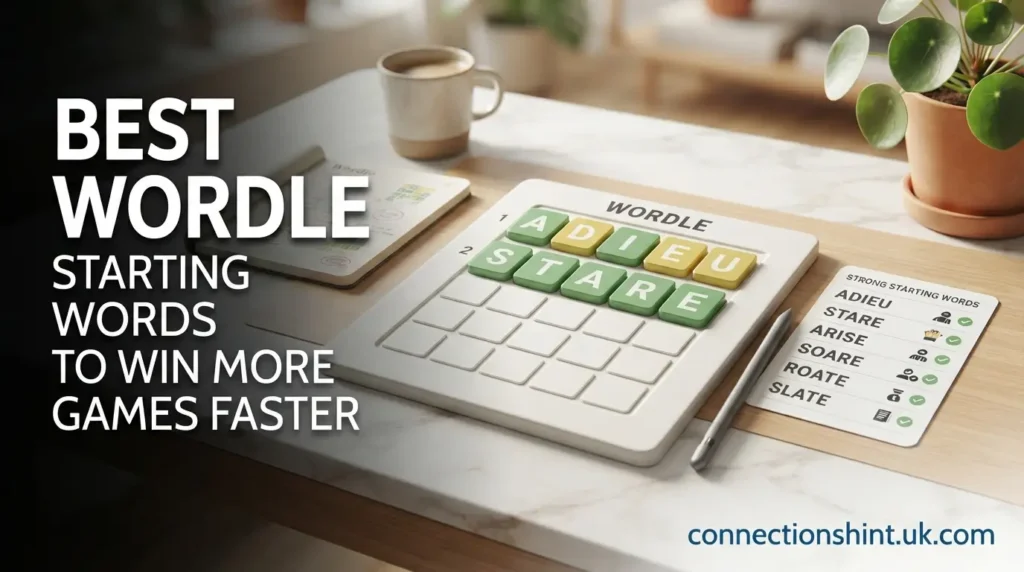
Choosing the best Wordle starting words based on statistics is one of the smartest ways to improve your Wordle performance. Instead of guessing randomly, statistical strategies use real data from thousands of Wordle puzzles to find which letters and words appear most often. This makes your first guess more powerful because it is based on probability, not luck. The main idea behind statistical Wordle play is simple: use words that contain the most common letters in English and Wordle answers. This increases your chances of getting useful feedback in the first attempt and helps you solve the puzzle faster and more consistently.
Most Common Letters in Wordle
The most common letters in Wordle are the foundation of a statistical strategy. Researchers and Wordle analysis tools have found that certain letters appear much more frequently in answers than others. These include E, A, R, T, S, L, N, and O.
When you use starting words that include these letters, you increase the probability of hitting correct letters early. For example, words like SLATE or CRANE work well because they combine several high-frequency letters in one guess. This helps you quickly eliminate wrong options and focus on likely solutions. Understanding letter frequency turns Wordle into a logical game instead of random guessing. You are no longer just trying words; you are testing the most probable letters first.
Words Recommended by WordleBot
WordleBot is a tool created to analyze Wordle performance and suggest better strategies. It evaluates how efficiently a word reduces possible answers and how much information it provides in a single guess.
Words like SLATE, CRANE, and LEAST are often recommended because they consistently give strong informational value. These words are balanced, meaning they include both vowels and consonants that appear frequently in Wordle solutions. The reason WordleBot favors these words is not that they are “correct guesses,” but because they help players gather the maximum amount of useful information. This leads to fewer wasted attempts and faster puzzle solving.
MIT and Data-Based Wordle Analysis
Data-based analysis from researchers, including computational studies often linked to institutions like MIT, focuses on solving Wordle using probability and optimization.
These studies simulate thousands of Wordle games and test which starting words produce the fastest average solutions. The results often show that words like SALET, ROATE, and TRACE perform extremely well because they maximize letter coverage and reduce uncertainty quickly. The key insight from these analyses is that the best starting words are not based on intuition; they are based on efficiency. The goal is to minimize the number of possible answers as fast as possible, and statistical models help identify which words achieve that best.
Wordle Starting Words to Avoid
Not all starting words in Wordle are helpful, and choosing the wrong ones can seriously reduce your chances of winning quickly. The best Wordle starting words strategy is not only about selecting strong options, but also about avoiding weak ones that give very little information. When your first guess is inefficient, you waste valuable opportunities to learn about the hidden word, which makes the game harder from the beginning. To play Wordle more effectively, you must understand which types of words slow you down. Weak starting words usually fail to test enough common letters, repeat unnecessary letters, or include rare characters that are unlikely to appear in answers. Avoiding these mistakes helps you get clearer clues and solve puzzles in fewer attempts.
Words With Repeated Letters
Words with repeated letters are weak starting choices because they reduce the number of unique letters you can test in a single guess. In Wordle, your first move should give you maximum information, and repeated letters do the opposite by wasting slots on letters you already tested once. This limits your ability to discover new clues in the early stage of the game.
For example, words like “BEEFY,” “LLAMA,” or “SISSY” are not good starting options because they repeat letters. If you use such words, you are essentially testing fewer different letters in one attempt. This slows down your progress because you may still not know enough about the hidden word after your first guess. Repeated-letter words also reduce your chances of hitting new correct letters. Since Wordle is about elimination and discovery, every unique letter matters. That is why strong starting strategies always focus on words with five different letters.
Rare Letter Combinations
Rare letter combinations are also poor choices for starting Wordle because they include letters that appear very infrequently in answers. Letters like Q, Z, X, and J are uncommon in English words, so using them early usually gives little or no useful feedback. This makes your first guess less effective in reducing possible answers.
For example, words like “JAZZY,” “QUIRK,” or “FJORD” may look interesting, but they are not efficient starting words. Most of the time, these letters will turn gray, meaning they provide no helpful information. As a result, you lose a valuable chance to test high-frequency letters that are more likely to appear. Instead of using rare letters early, it is better to save them for later guesses when you already have strong clues. The goal of a starting word is to maximize probability, not to experiment with unusual letter combinations.
Poor Opening Strategies
Poor opening strategies happen when players choose words randomly without thinking about structure, frequency, or logic. Many beginners make this mistake by using emotional, funny, or personal words that do not follow any strategic pattern. While this may feel fun, it is not effective for solving Wordle efficiently.
The main problem with poor strategies is that they do not provide enough useful information. If your first word contains uncommon letters or an unbalanced structure, you may learn very little about the hidden word. This forces you to spend extra guesses just to figure out basic letter patterns. A strong Wordle approach always focuses on logic. Good starting words use common vowels, frequent consonants, and no repeated letters. By avoiding poor strategies and using structured thinking, you can significantly improve your chances of solving the puzzle in fewer attempts.
Advanced Tips to Improve Your Wordle Strategy
Improving your best wordle starting words strategy is not only about choosing good opening words, but also about understanding how to think during the game. Advanced players focus on logic, patterns, and elimination instead of random guessing. When you apply these advanced tips, you start solving Wordle more efficiently and often finish in fewer attempts. The main idea behind advanced strategy is simple: every guess should give you maximum information. Instead of trying to “find the answer quickly,” you should aim to reduce the number of possible words step by step. This approach makes even difficult puzzles easier to solve.
Use Different Letters Early
Using different letters in your early guesses is one of the most powerful Wordle strategies because it helps you collect maximum information in the shortest time. In the first two or three guesses, your goal should be to test as many unique letters as possible instead of repeating the same ones.
When you use different letters, you quickly discover which characters are present in the hidden word. This helps you eliminate large groups of wrong answers early. For example, if your first word tests common vowels and your second word tests new consonants, you gain a much clearer picture of the solution. This method reduces guessing and increases logical thinking. Instead of hoping for luck, you are building knowledge step by step.
Avoid Guessing Randomly
Random guessing is one of the biggest mistakes in Wordle because it does not follow any logical pattern. When you guess randomly, you waste attempts without gaining meaningful information. This slows down your progress and makes difficult puzzles even harder.
Every guess in Wordle should have a purpose. It should either test new letters, confirm possible positions, or eliminate incorrect options. If your guess does not do any of these, it is not useful. By avoiding random guesses, you start thinking strategically. You analyze previous feedback and choose words that give you the highest chance of learning something new.
Learn Word Patterns
Learning word patterns is a very important advanced skill in Wordle. Many English words follow common structures, such as consonant blends like “TH,” “SH,” or “CH,” or vowel patterns like “EA” or “AI.” Recognizing these patterns helps you predict possible answers more easily.
When you understand patterns, you do not need to test every possible word. Instead, you can narrow down options based on structure. For example, if you know certain letters are correct, you can mentally form likely word combinations around them. This skill becomes more powerful with practice. Over time, you start recognizing patterns quickly, which significantly improves your solving speed.
When to Change Your Starting Word
Changing your starting word can sometimes improve your performance, especially if you feel stuck with one strategy. Some players use the same starting word every day for consistency, while others rotate between different strong words to gather varied information.
You should consider changing your starting word if it stops giving useful feedback or feels repetitive. Using different starting words helps you test different letter combinations and discover new solving patterns. However, the key is balance. You do not need to change your word every day, but experimenting occasionally can help you improve your overall strategy and become a more flexible player.
Common Mistakes Players Make in Wordle
Many players struggle in Wordle not because the game is difficult, but because they make small strategy mistakes that reduce their chances of solving the puzzle quickly. Even when using the best wordle starting words, these mistakes can waste guesses and slow down progress. Understanding what not to do is just as important as learning the right strategy. Most mistakes happen when players ignore feedback, guess without logic, or focus on random words instead of structured thinking. Avoiding these errors helps you improve faster and solve Wordle more consistently in fewer attempts.
Repeating Gray Letters
Repeating gray letters is one of the most common mistakes in Wordle. A gray letter means that the letter is not in the hidden word at all, so using it again in future guesses provides no value. Many players forget this and accidentally reuse the same incorrect letters.
This mistake slows down your progress because each guess should test new possibilities, not repeat confirmed wrong information. If you keep using gray letters, you reduce your chances of discovering correct letters and waste valuable attempts. A better approach is to mentally or visually note gray letters and completely avoid them in future guesses. This helps you focus only on useful information and improves your efficiency.
Ignoring Vowel Placement
Ignoring vowel placement is another major mistake that can make Wordle much harder than it needs to be. Vowels like A, E, I, O, and U are the foundation of most English words, so understanding where they belong is very important.
Some players identify vowels early but do not test different positions for them. This leads to confusion and incorrect assumptions about the word structure. For example, knowing that “A” is present is not enough; you also need to figure out where it fits in the word. By carefully testing vowel positions, you can quickly narrow down possible word structures and make smarter guesses. This simple step often makes solving Wordle much faster.
Choosing Fancy Words Too Early
Choosing fancy or complicated words too early is a mistake that many beginners make. These words may look interesting, but they often include rare letters or unusual combinations that do not provide useful information in the early stage.
When you use complex words at the beginning, you reduce your chances of hitting common letters that appear frequently in Wordle answers. This makes it harder to eliminate wrong options and slows your progress. A better strategy is to start with simple, high-frequency words that include common vowels and consonants. Once you have enough clues, you can then move on to more specific or complex guesses.
Best Two-Word Opening Combinations
Using the best wordle starting words is powerful on its own, but using a two-word opening strategy can take your gameplay to a much higher level. Instead of relying on one guess, two-word combinations allow you to test more letters early and gather maximum information in the first two moves. This reduces uncertainty and helps you narrow down the correct answer much faster. The main idea behind two-word strategies is simple: cover as many unique, high-frequency letters as possible without repeating them. This gives you a strong foundation and makes the rest of the puzzle easier to solve logically instead of guessing randomly.
TRAIN + CLOSE
TRAIN + CLOSE is a strong two-word opening strategy because it is designed to test a large number of high-frequency English letters in just two guesses. When you play Wordle, your main goal in the early stage is not to find the correct answer immediately, but to gather maximum information. This combination helps you do exactly that by covering many commonly used consonants and vowels efficiently.
Between these two words, you test important consonants like T, R, N, C, L, S, and key vowels like A, E, and O. These letters appear very frequently in Wordle answers, so checking them early increases your chances of getting useful feedback, such as green or yellow tiles. Once you know which of these letters exist in the hidden word, your guessing becomes much more focused and logical.
SLATE + ROUND
SLATE + ROUND is a highly effective two-word opening strategy because it is carefully designed to maximize letter coverage in the early stage of Wordle. The main purpose of this combination is not to guess the final answer, but to quickly gather as much useful information as possible about the hidden word. By using two strong, structured words, you significantly reduce uncertainty from the very beginning of the game.
SLATE works as a strong first guess because it includes several of the most common vowels and consonants in English words, such as S, L, A, T, and E. This helps you immediately test whether the word contains essential building blocks. ROUND complements it perfectly by introducing new high-value letters like R, N, D, and U, while also adding another important vowel. Together, these two words cover a wide range of frequently used letters without repeating too many of them.
CRANE + BUILT
CRANE + BUILT is a very efficient two-word starting strategy because it is designed to maximize unique letter coverage with almost no repetition. In Wordle, the most powerful early moves are the ones that test the widest range of common letters, and this combination does exactly that by spreading your guesses across two well-balanced word sets. The goal is simple: gather maximum clues in the first two turns so you can solve the puzzle using logic instead of guessing.
CRANE is a strong first word because it includes high-frequency consonants like C, R, N, along with important vowels A and E. This helps you quickly check whether the word contains core English building blocks. BUILT complements it by introducing a new set of useful letters such as B, L, T, and U, while also adding another vowel. Because these two words share very little overlap, they test almost completely different letter groups, which increases efficiency.
Frequently Asked Questions
What is the best Wordle starting word?
SLATE, CRANE, and TRACE are strong starting words because they include common letters that quickly give useful clues.
Is ADIEU a good Wordle starting word?
Yes, ADIEU is good because it quickly tests vowels, but it is weaker for testing consonants.
Should I use the same Wordle starting word every day?
You can use the same word daily, but changing it sometimes helps improve your strategy and letter coverage.
What letters are most common in Wordle?
The most common letters are E, A, R, T, S, L, N, and O.
What are the worst Wordle starting words?
Words with rare or repeated letters like Q, Z, X, and J are usually the worst choices.
Conclusion
Using the best wordle starting words is one of the most important strategies to improve your Wordle performance. A strong starting word helps you quickly discover common letters, understand vowel placement, and eliminate incorrect options early in the game. Instead of guessing randomly, you begin with a clear and logical approach that saves time and improves accuracy.
Words like SLATE, CRANE, TRACE, and ARISE are powerful because they contain frequently used letters and give strong early feedback. When combined with smart strategies like avoiding repeated letters and focusing on common patterns, you can solve Wordle puzzles more consistently in fewer attempts. The key is simple: the better your first word, the easier the entire game becomes.