
Welcome to connectionshint. CH words are words that contain the letter combination “CH,” which usually makes the familiar “ch” sound heard in words like chair, child, cheese, and chicken. These words are an important part of English vocabulary because they appear frequently in everyday conversations, books, schools, and workplaces. Learning CH words helps improve reading, spelling, pronunciation, and communication skills, making them especially useful for both children and English learners.
There are hundreds of CH words in English, ranging from simple words for beginners to more advanced vocabulary. Some CH words are used to describe people, places, objects, actions, and feelings, which makes them valuable in daily communication. By practicing CH words through reading, writing, and speaking activities, learners can expand their vocabulary, gain confidence in English, and develop stronger language skills over time.
What Are CH Words?
CH words are words that contain the letter combination “CH.” In English, these two letters often work together to create a unique sound that is different from the sounds of the letters C and H when they appear separately. You can find CH words in everyday conversations, books, schools, and workplaces. Common examples include chair, child, cheese, chicken, chocolate, and church. Learning these words helps improve vocabulary, reading ability, spelling, and pronunciation skills.
Understanding the CH Sound
The “CH” sound is one of the most common sounds taught in English phonics. In most cases, it is pronounced as a soft “ch” sound, which can be heard in words like chair, chat, chip, and chop. This sound is easy to recognize and appears in many everyday words, making it an important part of learning English pronunciation and spelling.
However, not all CH words follow the same pronunciation rule. Some words have different sounds because they originated from other languages. For example, “chef” is pronounced with a “sh” sound, while “chaos” uses a hard “k” sound at the beginning. Learning these pronunciation differences helps readers identify words correctly, improve speaking skills, and develop a better understanding of English vocabulary.
Why Learning CH Words Is Important
Learning CH words is important because they are commonly used in everyday English. From simple words like “chair” and “child” to more advanced words like “champion” and “challenge,” these words appear in conversations, books, school lessons, and written communication. Understanding CH words helps learners expand their vocabulary and recognize common word patterns, making reading and writing much easier.
For children and English language learners, practicing CH words can improve pronunciation, spelling, listening, and speaking skills. These words are often introduced during phonics lessons because they help learners connect sounds with letter combinations. As learners become familiar with more CH words, they gain confidence in using English and can communicate more clearly in both academic and real-life situations.
Common CH Words in English
CH words are commonly used in everyday English and play an important role in building vocabulary and language skills. These words appear in daily conversations, books, schools, and many real-life situations, making them essential for English learners. From simple words like chair and child to more advanced words like challenge and champion, CH words help improve reading, writing, spelling, and pronunciation. Learning and practicing these words regularly can make communication easier, increase confidence, and support overall English language development.
Everyday CH Words
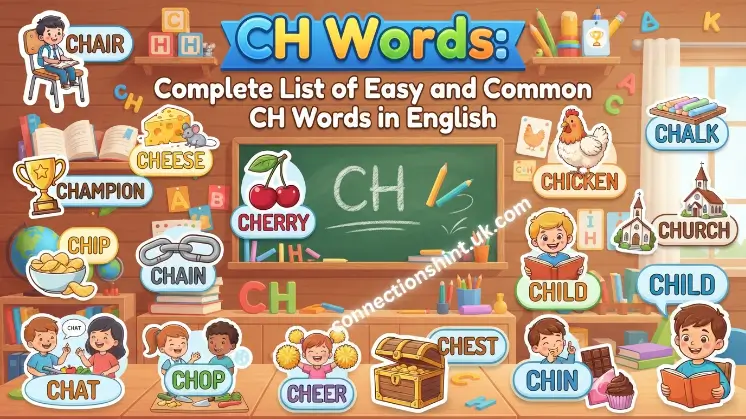
Many CH words are used in daily life and describe common objects, people, foods, and actions. Words such as chair, cheese, chicken, chocolate, and church are familiar to most English speakers and are often introduced during early vocabulary lessons. These words are easy to remember because learners encounter them frequently in real-life situations.
Learning everyday CH words helps build a strong vocabulary foundation. When learners understand these common words, they can read simple texts more easily and express themselves with greater confidence. Practicing these words through speaking, writing, and reading activities can significantly improve language skills.
Meaning and Example Sentences
Understanding the meaning of CH words is essential for using them correctly in conversations and writing. Each word has a specific meaning and can be used in different situations. Learning words along with their meanings helps learners remember them more effectively and understand how they are used in context.
Using example sentences is one of the best ways to learn new vocabulary. Sentences show how CH words function in everyday communication and make it easier to remember their meanings. By reading and creating sentences with CH words, learners can improve both their grammar and vocabulary skills at the same time.
Read Also: 100+ Words with X: Complete List, Meanings and Examples Guide
3-Letter CH Words
3-letter CH words are the simplest form of words that include the “CH” sound. These words are not very common in daily English, but they are very useful for beginners who are just starting to learn phonics and vocabulary. They help learners understand how the “CH” sound works in short and simple patterns. Even though they are limited in number, they build a strong base for learning longer CH words later. Learning these short CH words is important because they improve sound recognition and pronunciation skills. When learners become familiar with these basic forms, it becomes easier for them to read and pronounce more complex words. Teachers often use such simple words in early learning stages to help students gain confidence in English.
List of 3-Letter Words
The most common 3-letter CH words include simple combinations like cha, che, and chi. These are often found in phonics exercises, language learning materials, or as parts of longer words. While they may not always stand alone as full English words, they still play an important role in understanding how the “CH” sound is formed.
These short forms help learners break down pronunciation step by step. By practicing them regularly, students can easily recognize the “CH” sound in longer words and improve their reading speed. This makes learning English easier and more structured, especially for beginners.
Examples and Uses
3-letter CH words are mostly used in learning environments such as classrooms, phonics lessons, and spelling activities. For example, cha may appear in names or borrowed terms, while chi is often used in cultural or language-specific contexts. Even though they are not frequently used in everyday English sentences, they are still valuable for early learning practice.
These words help learners build confidence before moving on to longer and more difficult CH words. By practicing them through reading, speaking, and repetition, students can strengthen their understanding of English sound patterns. This step-by-step learning approach makes vocabulary building easier and more effective.
4-Letter CH Words
4-letter CH words are simple and important words for beginners in English learning. These words clearly show the “CH” sound, which helps learners understand pronunciation and spelling patterns easily. Many of these CH words are commonly used in early vocabulary lessons because they are short, clear, and easy to remember. Learning these CH words also helps improve reading speed and writing accuracy. Since the words are small, learners can quickly practice them and start using them in daily communication. This builds confidence and creates a strong foundation for learning more advanced vocabulary later.
Popular 4-Letter CH Words
Some popular 4-letter CH words include chat, chef, chip, chin, chop, chew, chap, and chum. These words are often taught in early English classes because they help students recognize the “CH” sound easily. Each word has a simple structure, which makes pronunciation and spelling easier for beginners.
These words are also useful in everyday situations. For example, “chat” is used for talking informally, “chef” refers to a cook, and “chip” means a small piece of something. Learning these meanings helps students understand how CH words are used in real life.
Example Sentences
Example sentences make it easier to understand how 4-letter CH words work in real communication. When learners see words used in context, they remember them better and can use them correctly in their own writing and speaking.
For example, we can say: “We had a chat after school,” “The chef cooked delicious food,” and “I ate a chip during lunch.” Other examples include “He touched his chin,” “Please chop the vegetables,” and “She likes to chew gum.” Practicing these sentences helps learners improve fluency and confidence in English.
5-Letter CH Words
5-letter CH words are very common in English and are widely used in everyday communication. These words are slightly longer than basic vocabulary, but they are still easy for learners to understand and remember. Most of these CH words appear in daily conversations, books, and classroom learning, making them very useful for improving English skills. Learning 5-letter CH words helps students improve spelling, pronunciation, and reading fluency. Because these words are used frequently, practicing them regularly can make it easier to understand written and spoken English. They also help learners move from basic vocabulary to more advanced language use in a smooth way.
Common 5-Letter CH Words
Some common 5-letter CH words include chair, child, chain, chalk, cheer, chest, chief, chord, charm, and chase. These words are important because they are used in different situations,s such as talking about people, objects, actions, and feelings. Each word has a simple structure but carries a meaningful use in daily English.
These CH words are often introduced in early and intermediate English learning because they help students build stronger vocabulary. By learning these words, learners can easily recognize them in reading passages and use them correctly in sentences.
Meanings and Examples
Understanding the meaning of 5-letter CH words is important for using them correctly in communication. Each word has its own definition and can be used in different contexts, which makes learning more practical and useful.
For example, a chair is used for sitting, and a child refers to a young person. A chain is a set of connected links, while chalk is used for writing on boards. We can say, “She is sitting on a chair,” “The child is playing outside,” “He fixed the chain of the bike,” and “The teacher wrote with chalk.” Practicing these examples helps learners understand how CH words are used in real-life situations and improves overall English fluency.
6-Letter and Longer CH Words
6-letter and longer CH words are more advanced vocabulary items in English. These words are commonly used in reading passages, formal writing, and daily communication. They help learners move beyond basic vocabulary and improve their overall language skills. By learning longer CH words, students can understand more complex texts and express their ideas more clearly. Practicing these CH words is important for building strong English fluency. Although they are longer and sometimes more difficult, they follow the same “CH” sound patterns that learners already know. This makes them easier to understand once the basic foundation is strong.
6-Letter CH Words
Some common 6-letter CH words include change, chance, choose, church, cherry, and chrome. These words are frequently used in both spoken and written English. Each word has an important meaning and can be used in different contexts, such as describing actions, places, or objects.
For example, we can say “People change over time,” “Everyone deserves a chance,” and “You should choose wisely.” These sentences show how 6-letter CH words are used in real-life communication. Learning these examples helps students improve both understanding and usage of English vocabulary.
Advanced CH Vocabulary
Advanced CH words include more complex terms such as champion, challenge, chemistry, character, charity, and chronicle. These words are often used in academic writing, storytelling, and professional communication. They help learners express deeper ideas and understand higher-level English texts.
For example, “She is a champion in sports,” “Life can be full of challenges,” and “Chemistry is an important science subject.” By learning advanced CH words, students can expand their vocabulary and improve their confidence in both speaking and writing English in more formal situations.
Positive CH Words
Positive CH words are words that carry happy, encouraging, and uplifting meanings in English. These words are often used in daily conversations, motivational writing, and friendly communication. Learning positive CH words helps learners express good feelings, appreciation, and confidence more naturally. Using positive vocabulary is important because it improves communication and creates a friendly tone in both speaking and writing. When learners understand positive CH words, they can easily share emotions like happiness, kindness, success, and motivation in different situations.
Positive Words Beginning with CH
Some common positive CH words include champion, cheerful, charming, charity, choice, and cheer. These words are used to describe good qualities, positive actions, and inspiring situations. Each word has a strong and encouraging meaning that can improve the tone of communication.
For example, a champion is someone who wins or succeeds, cheerful means happy and full of energy, and charming describes someone pleasant and attractive in personality. These words are often used in daily English to describe positive behavior and attitudes.
How to Use Positive CH Words
Positive CH words can be used in many real-life situations, such as speaking, writing, storytelling, and motivational messages. Using these words helps make communication more respectful, friendly, and encouraging.
For example, we can say “She is a cheerful student,” “He is a champion in sports,” and “They support charity work in their community.” These sentences show how positive CH words can be used to describe good qualities and actions. Regular use of these words helps learners develop a more positive and confident way of expressing themselves in English.
CH Words for Kids
CH words for kids are simple, easy, and fun words that help young learners start building their English vocabulary. These words are usually introduced in early education because they clearly show the “CH” sound and are easy for children to pronounce. Learning CH words at an early age helps kids improve reading, speaking, and spelling skills naturally and enjoyably. Teachers and parents often use pictures, stories, and games to teach CH words so children can learn faster. These activities make learning interactive and help kids remember words for a long time. Starting with basic CH words builds a strong foundation for future English learning.
Easy CH Words for Kindergarten
Easy CH words for kindergarten include simple and commonly used words that children can quickly understand. Some examples are chair, chip, chin, chat, chalk, cheese, chick, chest, chop, and cheer. These words are short, clear, and often related to things children see in daily life.
These CH words are perfect for beginners because they are easy to pronounce and remember. When children learn these words early, they become more confident in reading simple sentences and recognizing word patterns in English books.
CH Word Activities
Fun activities make learning CH words more interesting for kids. Teachers can use games like matching pictures with words, spelling quizzes, and word repetition exercises to help children learn faster. Storytelling using CH words also helps kids understand how these words are used in real life.
For example, children can act out words like “chase” or “cheer” in a classroom game. These activities improve memory and make learning enjoyable instead of boring. Regular practice through play helps children master CH words naturally.
Flashcard Learning Tips
Flashcards are one of the best tools for learning CH words. Each flashcard can show a picture on one side and the word on the other side. This helps children connect visuals with vocabulary, making it easier to remember meanings.
To use flashcards effectively, parents and teachers should repeat the words regularly and encourage children to say them aloud. Mixing different CH words in practice sessions helps improve recognition and pronunciation. With consistent use, flashcards can significantly improve a child’s vocabulary and confidence in English learning.
CH Words for Kids
CH words for kids are simple, easy, and fun words that help young learners start building their English vocabulary. These words are usually introduced in early education because they clearly show the “CH” sound and are easy for children to pronounce. Learning CH words at an early age helps kids improve reading, speaking, and spelling skills naturally and enjoyably. Teachers and parents often use pictures, stories, and games to teach CH words so children can learn faster. These activities make learning interactive and help kids remember words for a long time. Starting with basic CH words builds a strong foundation for future English learning.
Easy CH Words for Kindergarten
Easy CH words for kindergarten include simple and commonly used words that children can quickly understand. Some examples are chair, chip, chin, chat, chalk, cheese, chick, chest, chop, and cheer. These words are short, clear, and often related to things children see in daily life.
These CH words are perfect for beginners because they are easy to pronounce and remember. When children learn these words early, they become more confident in reading simple sentences and recognizing word patterns in English books.
CH Word Activities
Fun activities make learning CH words more interesting for kids. Teachers can use games like matching pictures with words, spelling quizzes, and word repetition exercises to help children learn faster. Storytelling using CH words also helps kids understand how these words are used in real life.
For example, children can act out words like “chase” or “cheer” in a classroom game. These activities improve memory and make learning enjoyable instead of boring. Regular practice through play helps children master CH words naturally.
Flashcard Learning Tips
Flashcards are one of the best tools for learning CH words. Each flashcard can show a picture on one side and the word on the other side. This helps children connect visuals with vocabulary, making it easier to remember meanings.
To use flashcards effectively, parents and teachers should repeat the words regularly and encourage children to say them aloud. Mixing different CH words in practice sessions helps improve recognition and pronunciation. With consistent use, flashcards can significantly improve a child’s vocabulary and confidence in English learning.
How to Pronounce CH Words Correctly
Pronouncing CH words correctly is very important for clear and confident English speaking. Most CH words follow a simple pronunciation pattern, but some words can sound different depending on their origin. Learning these differences helps learners speak more naturally and understand spoken English better. Good pronunciation also improves listening skills because learners can easily recognize words when others speak. By practicing CH words regularly, students can develop better fluency and avoid common pronunciation mistakes.
CH Pronounced as “Ch”
In most cases, CH words are pronounced with a soft “ch” sound, like “chuh.” This is the most common sound in English and appears in many everyday words. Examples include chair, child, cheese, chicken, chocolate, chat, chip, and chop.
This sound is easy to learn because it is consistent in many words. Learners should practice saying these CH words slowly and clearly at first, then gradually increase speed. Repetition helps improve pronunciation and makes speaking more natural over time.
Special CH Pronunciations
Some CH words do not follow the normal “ch” sound rule. These words come from different languages and have unique pronunciations. For example, chef is pronounced with a “sh” sound, chaos uses a hard “k” sound, and choir starts with a “kw” sound.
These special cases can be confusing at first, but they become easier with practice. Learning them as exceptions helps learners avoid mistakes and improves overall understanding of English pronunciation. Listening to native speakers and repeating these words is the best way to master them.
Tips to Learn and Remember CH Words
Learning and remembering CH words becomes much easier when you use smart and consistent study methods instead of simple memorization. The goal is not only to learn new words but to understand them deeply so you can use them in real conversations, writing, and reading. When learners practice CH words in different ways, their brain stores the information for a longer time, making vocabulary stronger and more natural.
Reading Practice
Reading practice is one of the most powerful ways to learn CH words because it shows how words are used in real sentences. When learners read books, stories, or articles, they naturally see CH words in different contexts, which helps them understand meaning without translation. This improves both comprehension and vocabulary at the same time.
A good method is to read slowly and focus on identifying CH words while reading. When you find a new word, try to understand its meaning from the sentence first, then check it if needed. Reading aloud is even more effective because it improves pronunciation, fluency, and confidence. Over time, repeated reading makes CH words familiar and easy to recognize instantly.
Writing Practice
Writing practice helps learners deeply understand CH words because it forces them to use the words actively instead of just reading them. When you write sentences using new words, your brain works harder to remember spelling, meaning, and correct usage. This makes learning more permanent and effective.
A useful technique is to write short daily sentences using different CH words such as chair, child, cheese, or change. You can also write small paragraphs or stories that include multiple CH words. Keeping a vocabulary notebook is very helpful because you can revise words regularly and track your progress. The more you write, the more natural these words become in your mind.
Vocabulary Building Techniques
Vocabulary-building techniques help learners organize and strengthen their knowledge of CH words in a structured way. One effective method is grouping words by categories such as food (cheese, chicken, chocolate), actions (chase, choose, change), and people (child, champion, chief). This helps the brain connect similar ideas and improves memory retention.
Another powerful technique is using repetition and active recall. Flashcards, word games, and quizzes help reinforce learning interactively. Speaking practice is also very important because using CH words in real conversations improves fluency and confidence. When learners consistently use these techniques together, they develop a strong and long-lasting vocabulary foundation.
Common Mistakes When Using CH Words
Many learners make small but important mistakes when using CH words in English. These mistakes usually happen because learners focus only on memorizing words instead of understanding pronunciation and spelling rules. By identifying these common errors, learners can improve their accuracy and become more confident in using CH words in both speaking and writing.
Spelling Errors
One of the most common mistakes in CH words is incorrect spelling. Many learners forget the correct placement of “c” and “h” together or mix letters due to confusion. For example, writing “chease” instead of “cheese” or “childd” instead of “child” are typical spelling errors.
These mistakes often happen when learners do not practice writing regularly. The best way to improve spelling is through repetition, writing exercises, and reading frequently. When learners see correct CH words many times, they naturally remember the correct spelling patterns.
Pronunciation Mistakes
Pronunciation errors are also common when learning CH words. Some learners may pronounce every CH word the same way, even when the sound changes. For example, saying “chef” with a hard “ch” sound instead of the correct “sh” sound is a common mistake.
To improve pronunciation, learners should listen to native speakers and repeat words slowly and clearly. Practicing regularly helps train the mouth and ears to produce the correct sounds. Over time, the correct pronunciation of CH words becomes natural and automatic.
Confusing CH and SH Sounds
Another frequent mistake is confusing the “CH” sound with the “SH” sound. Words like “chair” and “share” or “chip” and “ship” are often mixed up by beginners. This happens because both sounds are similar but used in different words.
To avoid this confusion, learners should practice listening exercises and focus on the difference between “ch” (as in chair) and “sh” (as in ship). Repeating word pairs and using them in sentences helps improve clarity. With regular practice, learners can easily distinguish between CH words and “SH” words and use them correctly in communication.
Frequently Asked Questions
What are common CH words?
Common CH words are everyday English words that contain the “CH” sound. Examples include chair, child, cheese, chicken, chocolate, church, change, and chase. These words are widely used in daily communication, books, and classroom learning, making them very important for building vocabulary.
Why are CH words important in English learning?
CH words are important because they help learners improve reading, writing, pronunciation, and spelling skills. They are often introduced in early phonics lessons because they are easy to recognize and pronounce. Learning these words helps build a strong foundation in English.
Do all CH words have the same pronunciation?
No, not all CH words are pronounced the same way. Most CH words use the soft “ch” sound like in chair and chip, but some words have different sounds. For example, chef is pronounced with a “sh” sound, and chaos starts with a “k” sound.
How can I improve my CH words vocabulary?
You can improve your CH words vocabulary by reading regularly, writing sentences, practicing pronunciation, and using flashcards. Repeating words in different contexts helps you remember them better and use them correctly in real conversations.
What are easy CH words for beginners?
Easy CH words for beginners include chair, chip, chin, chat, chalk, cheese, chick, chop, and cheer. These words are simple, commonly used, and perfect for building early English vocabulary skills.
Conclusion
Learning CH words is an important step in improving English vocabulary, pronunciation, and overall communication skills. These words are commonly used in everyday life, from simple words like chair and child to more advanced words like challenge and champion. Because of their frequent use, mastering CH words helps learners understand English more easily and speak more confidently.
By practicing CH words regularly through reading, writing, speaking, and listening, learners can build a strong language foundation. Understanding their meanings, pronunciation patterns, and common mistakes also makes learning more effective. With consistent practice, anyone can improve their English skills and use CH words correctly in real-life situations.