
Welcome to connectionshint. Detritus is a term commonly used in biology, ecology, and geology to describe dead organic material or fragmented matter that accumulates in natural environments. Although many people think of it as simple waste, detritus plays a critical role in maintaining healthy ecosystems and supporting life on Earth.
From fallen leaves in forests to organic particles at the bottom of lakes and oceans, detritus serves as an important source of nutrients for many organisms. Understanding detritus helps us better appreciate how nature recycles materials and sustains ecological balance. In this guide, you will learn what detritus is, how it forms, its different types, and why it is so important.
What Is Detritus?
Detritus is dead organic material that comes from plants, animals, and other living organisms after they die or shed parts of their bodies. It is found in almost every ecosystem, including forests, grasslands, rivers, lakes, and oceans. Many people think of detritus as waste, but in reality, it is an essential part of nature because it helps recycle nutrients and supports many forms of life.
Simple Definition of Detritus
In simple words, detritus is the dead and decaying material that remains after living organisms die or lose parts of their bodies. Common examples include fallen leaves, dead branches, animal remains, feathers, and animal waste. These materials collect on the ground or in water and gradually break down over time.
Although detritus may seem useless at first glance, it plays an important role in natural ecosystems. As it decomposes, valuable nutrients are released back into the environment, helping plants grow and providing food for many small organisms. This natural recycling process keeps ecosystems healthy and productive.
Scientific Meaning in Biology
In biology, detritus refers to all non-living organic matter that originates from living organisms. This includes dead plant tissues, animal remains, shed skin, feathers, feces, and other biological materials that are no longer alive. Scientists study detritus because it serves as a major source of energy and nutrients within ecosystems.
Biologists consider detritus a key part of nutrient cycling. Organisms such as bacteria, fungi, earthworms, and insects break down detritus into simpler substances. During this process, important nutrients like nitrogen, phosphorus, and carbon are returned to the soil and water, where they can be used again by plants and other living organisms.
Difference Between Detritus and Living Matter
The main difference between detritus and living matter is that detritus is no longer alive, while living matter consists of organisms that are actively carrying out life processes. Living organisms can grow, reproduce, respond to their environment, and use energy to survive. In contrast, detritus cannot perform any of these functions because it is made up of dead organic material.
Another important difference is their role in ecosystems. Living matter produces, consumes, and transfers energy through food chains, while detritus serves as a source of nutrients after organisms die. Over time, all living organisms eventually become detritus, allowing their nutrients to be recycled and reused by new generations of plants and animals.
Read also: Wordle Today: Daily Hints, Answer, Tips & Winning Strategy
Types of Detritus
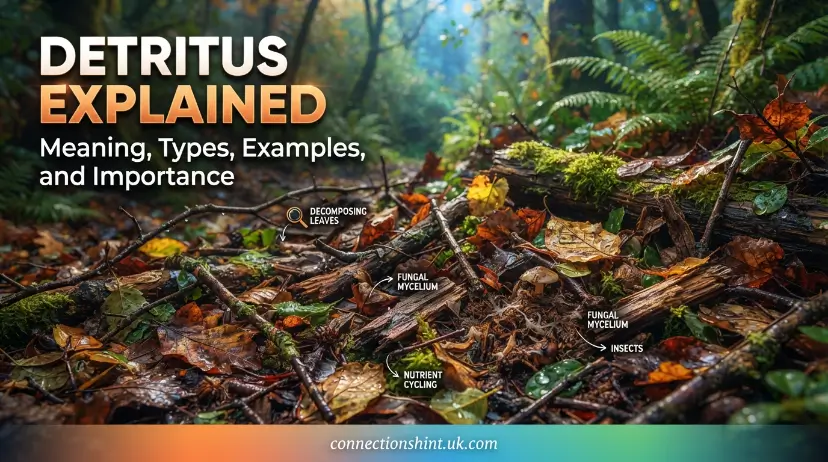
Detritus can come from many different sources in nature. It is generally classified according to the type of organism from which it originates. The three main types of detritus are plant-based detritus, animal-based detritus, and microbial detritus. Each type plays an important role in nutrient recycling and helps maintain the balance of ecosystems.
Plant-Based Detritus
Plant-based detritus consists of dead plant materials that accumulate in the environment. Common examples include fallen leaves, dead grass, twigs, branches, bark, flowers, fruits, and decaying roots. Forest floors often contain large amounts of plant-based detritus, creating a thick organic layer that covers the soil surface.
This type of detritus is extremely important because it provides nutrients and organic matter for the soil. As leaves and other plant materials decompose, they release essential nutrients such as nitrogen, phosphorus, and potassium. These nutrients become available to growing plants, helping maintain healthy and productive ecosystems.
Animal-Based Detritus
Animal-based detritus comes from dead animals and materials produced by animals during their lives. Examples include animal remains, shed skin, feathers, fur, scales, bones, and fecal matter. When animals die or lose body parts naturally, these materials become part of the detritus layer within an ecosystem.
This form of detritus contains valuable nutrients and organic compounds that support decomposers and detritivores. Bacteria, fungi, insects, and scavengers break down animal-based detritus, releasing nutrients back into the environment. These nutrients are then reused by plants and other organisms, contributing to the continuous cycle of life.
Microbial Detritus
Microbial detritus consists of the remains of microscopic organisms such as bacteria, fungi, algae, and other microorganisms after they die. Although these organisms are very small, they exist in enormous numbers, making microbial detritus a significant part of many ecosystems.
Microbial detritus plays a crucial role in soil and aquatic environments because it contributes organic matter and nutrients to the ecosystem. As microbial cells decompose, they help improve soil fertility and support nutrient cycling. Scientists have found that microbial detritus is an important source of stable organic matter that can remain in soil for long periods, helping maintain ecosystem health and productivity.
Role of Detritus in Ecosystems
Detritus plays a fundamental role in maintaining the health and stability of ecosystems. Although it consists of dead organic material, it is far from useless. In fact, detritus serves as a vital link in the movement of energy and nutrients through the environment. By supporting various organisms and natural processes, detritus helps sustain life in both terrestrial and aquatic ecosystems.
Food Source for Detritivores
One of the most important functions of detritus is serving as a food source for detritivores. Detritivores are organisms that feed directly on dead and decaying organic matter. Common examples include earthworms, millipedes, woodlice, crabs, and certain insect larvae. These organisms consume detritus and break it into smaller particles, making it easier for decomposers to continue the breakdown process.
Without detritus, many detritivores would struggle to survive because it provides a major source of energy and nutrients. As detritivores feed on detritus, they become part of larger food webs and serve as prey for birds, reptiles, fish, and mammals. This makes detritus an essential foundation for many ecosystem food chains.
Nutrient Recycling Process
Detritus plays a key role in nutrient recycling by returning essential elements to the environment. When plants and animals die, the nutrients stored in their tissues become locked within the dead material. Through decomposition, bacteria, fungi, and other decomposers break down detritus into simpler substances.
During this process, important nutrients such as nitrogen, phosphorus, potassium, and carbon are released into the soil and water. Plants absorb these nutrients to support growth, and animals obtain them by feeding on plants or other organisms. In this way, detritus helps maintain the continuous cycling of nutrients that is necessary for healthy ecosystems.
Contribution to Soil Formation
Detritus contributes significantly to the formation and improvement of soil. As plant and animal materials decompose, they create organic matter known as humus. Humus is a dark, nutrient-rich substance that improves soil quality and supports plant growth.
The presence of detritus in soil enhances its structure, increases water-holding capacity, and promotes the activity of beneficial microorganisms. Over time, the accumulation and decomposition of detritus help create fertile soils that support forests, grasslands, crops, and many other forms of vegetation. Without detritus, soil formation would be much slower, and ecosystems would be less productive.
Detritus Food Chain Explained
The detritus food chain is a type of food chain that begins with dead and decaying organic matter rather than living plants. In many ecosystems, especially forests, wetlands, and aquatic environments, a large amount of energy flows through the detritus food chain. This system helps recycle nutrients and ensures that dead organic material is converted into forms that can be used by other organisms.
Unlike food chains that start with green plants, the detritus food chain depends on decomposing material such as fallen leaves, dead animals, animal waste, and decaying wood. Organisms that feed on detritus play a crucial role in transferring energy through the ecosystem and supporting nutrient cycling.
Step-by-Step Process
The detritus food chain begins when plants, animals, or other organisms die or produce waste materials. These dead organic materials accumulate in the environment and become detritus. Instead of being wasted, this material serves as a valuable source of energy and nutrients for other organisms.
The next step involves detritivores and decomposers such as earthworms, bacteria, fungi, and insects. These organisms consume or break down the detritus, releasing nutrients into the soil or water. Small predators then feed on the detritivores, and larger predators feed on those organisms. A simple example of a detritus food chain is:
Fallen leaves → Earthworms → Birds → Hawks
Through this process, energy stored in dead organic matter continues to move through the ecosystem rather than being lost.
Comparison with Grazing Food Chain
The detritus food chain and the grazing food chain are both important pathways for energy flow, but they begin in different ways. The grazing food chain starts with living green plants, which produce food through photosynthesis. Herbivores consume these plants, and carnivores feed on the herbivores.
In contrast, the detritus food chain starts with dead organic matter instead of living plants. Detritivores and decomposers are the first organisms involved, followed by predators that feed on them. While the grazing food chain transfers energy directly from living plants to animals, the detritus food chain recycles energy and nutrients from dead materials, making it essential for ecosystem sustainability.
Examples of Detritus
Detritus can be found in almost every natural environment. It includes a wide variety of dead organic materials that originate from plants, animals, and other living organisms. These materials may seem like waste, but they are extremely important because they provide nutrients for decomposers and detritivores. Understanding common examples of detritus helps us see how nature continuously recycles organic matter and maintains ecosystem health.
Fallen Leaves
Fallen leaves are one of the most common forms of detritus found in forests, parks, and gardens. When trees shed their leaves, the leaves accumulate on the ground and gradually decompose through the action of fungi, bacteria, and small animals.
Examples of fallen leaves as detritus:
- Dry leavecoverng a forest floor.
- Leaves are collected beneath trees during autumn.
- Decaying leaves mixed into garden soil.
- Leaf litter is found in parks and grasslands.
Dead Animals
Dead animals become detritus when they die and begin to decompose. Their bodies contain nutrients that are released back into the environment through the activities of scavengers, decomposers, and microorganisms.
Examples of dead animals as detritus:
- Dead insects are lying on the ground.
- Fish remain in rivers and lakes.
- Bird carcasses in natural habitats.
- Small mammals decomposing in forests.
Wood Debris
Wood debris consists of dead branches, fallen tree trunks, bark, and other woody materials. As these materials break down over time, they contribute organic matter to the soil and provide habitats for many organisms.
Examples of wood debris as detritus:
- Fallen tree branches after storms.
- Rotting logs on forest floors.
- Pieces of bark detached from old trees.
- Dead twigs scattered across woodland areas.
Animal Waste
Animal waste is another important form of detritus because it contains organic matter and nutrients that can be reused within ecosystems. Many organisms feed on or decompose animal waste, helping return nutrients to the soil.
Examples of animal waste as detritus:
- Cow dung in grasslands and farms.
- Bird droppings on soil and rocks.
- Deer feces in forests.
- Organic waste produced by aquatic animals.
These examples show that detritus is not simply discarded material. Instead, it is a valuable resource that supports nutrient cycling, soil fertility, and the survival of many organisms within ecosystems.
Common Misconceptions About Detritus
Detritus is often misunderstood as useless or dirty material because it is made up of dead plants, animals, and other organic matter. Blog In reality, detritus is a very important part of ecosystems because it helps recycle nutrients and supports many forms of life. Many people think it is just waste that should be removed, but nature uses detritus as a key resource to maintain balance in the environment. Without detritus, ecosystems would not function properly because nutrients would not return to the soil, and new life would struggle to grow.
Not Just “Waste”
A common misconception is that detritus is only waste material with no value. However, this is not true because detritus still contains important nutrients and organic matter that are reused in nature. It becomes food for many organisms and helps in the natural recycling process.
Key points:
- Detritus includes dead leaves, animals, and organic waste.
- It provides nutrients like nitrogen and carbon to the soil.
- It is an important food source for detritivores and decomposers.
- It supports the natural recycling system in ecosystems.
Not Harmful
Another wrong belief is that detritus is harmful or dirty and should always be removed. In natural ecosystems, detritus is not harmful at all. Instead, it improves soil quality and supports the growth of plants and microorganisms.
Key points:
- Natural detritus helps improve soil fertility.
- It supports bacteria, fungi, and other decomposers.
- It plays a role in maintaining ecosystem balance.
- Only excessive human waste (not natural detritus) causes pollution problems.
Essential for Life Cycle
Many people do not realize that detritus is essential for the life cycle of ecosystems. When organisms die, they become detritus, and this starts the process of decomposition and nutrient recycling. This process ensures that life continues in a balanced way.
Key points:
- Every organism eventually becomes detritus after death.
- It helps recycle nutrients like phosphorus and nitrogen.
- It supports new plant growth and new life forms.
- It connects death with renewal in the ecosystem cycle.
Frequently Asked Questions About Detritus
What is detritus in simple words?
Detritus is dead and decaying organic material, such as fallen leaves, dead animals, twigs, and waste. It is found in natural environments like forests, rivers, lakes, and soil. Instead of being useless, detritus is broken down by decomposers and reused in nature.
Why is detritus important in ecosystems?
Detritus is important because it helps recycle nutrients back into the environment. When it decomposes, it releases essential nutrients like nitrogen and phosphorus into the soil. These nutrients support plant growth and maintain ecosystem balance. It also provides food for many small organisms.
What organisms feed on detritus?
Organisms that feed on detritus are called detritivores. Common examples include earthworms, millipedes, crabs, beetles, and insect larvae. These organisms break down detritus into smaller pieces, making it easier for bacteria and fungi to decompose it further.
Is detritus harmful to the environment?
Natural detritus is not harmful. In fact, it is very beneficial for ecosystems. It improves soil quality, supports microorganisms, and helps in nutrient cycling. However, human-generated waste is different and can cause pollution if not managed properly.
What is the difference between detritus and decomposition?
Detritus is the dead organic material itself, while decomposition is the process by which that material is broken down. Decomposition is carried out by bacteria, fungi, and other organisms, turning detritus into nutrients that can be reused by plants.
Conclusion
Detritus is an essential part of every ecosystem, even though it is made up of dead and decaying organic material. It includes fallen leaves, dead animals, wood debris, and waste that naturally accumulates in the environment. Instead of being useless, detritus plays a major role in keeping ecosystems alive, and through decomposition, detritus helps recycle important nutrients back into the soil and water. These nutrients support plant growth and provide energy for many organisms in the food chain.
It also contributes to soil formation, improves fertility, and supports detritivores and decomposers that depend on it for susurvivalverall, detritus is a key link in the cycle of life. It connects death with new life by ensuring that nothing in nature goes to waste. Understanding detritus helps us appreciate how nature continuously reuses materials to maintain a healthy and sustainable environment.