
Welcome to connectionshint. Hang five is one of the most iconic and stylish maneuvers in longboard surfing. It refers to riding a wave while placing five toes from one foot over the front edge (nose) of the surfboard. This move requires balance, timing, and strong control over the board while maintaining smooth wave flow.
For many surfers, learning hang five is a milestone that represents progression from beginner to advanced longboarding skills. It blends technique with style, making it both a performance skill and a cultural expression within surfing communities. Mastering it takes patience, practice, and the right wave conditions.
What Is Hang Five in Surfing?
Hang Five is one of the most recognizable maneuvers in longboard surfing, combining balance, timing, and style into a single movement. The trick involves walking toward the front of a longboard and placing five toes of one foot over the nose while continuing to glide smoothly across the wave. It is a classic example of nose riding and remains a defining skill for surfers who want to improve their board control and embrace traditional surfing techniques.
Simple Definition of Hang Five
The term Hang Five refers to a surfing maneuver where a rider positions one foot at the very front of a longboard, allowing all five toes to extend beyond the nose of the board. While it may look effortless, maintaining this position requires excellent balance, proper timing, and a good understanding of wave movement. It is considered one of the foundational skills in surf technique and longboard surfing.
Unlike many high-speed surfing maneuvers, Hang Five focuses on smoothness and control rather than power. Surfers gradually walk toward the nose instead of making sudden movements, allowing the board to stay stable while riding the wave. Successfully performing this maneuver demonstrates confidence, precision, and mastery of surfboard control.
Origin of the Term in Surf Culture
The name Hang Five comes from the five toes of one foot hanging over the front edge of the surfboard. The expression became popular during the golden era of classic surfing, when longboards dominated the sport and stylish wave riding was highly valued. As surfers developed new ways to showcase balance and elegance, nose riding quickly became one of the most admired techniques.
Over the years, Hang Five has remained an iconic part of surf culture, representing the traditional roots of the sport. Although modern surfing includes many aerial tricks and aggressive turns, this maneuver continues to symbolize grace, flow, and technical skill. It is still featured in longboard competitions and celebrated by surfers who appreciate the timeless style of traditional longboarding.
Why It’s Popular in Longboard Surfing
One reason Hang Five is so popular is that it perfectly showcases the smooth, flowing style that defines longboard surfing. Instead of relying on speed or explosive movements, surfers demonstrate their ability to maintain balance while riding near the very front of the board. The maneuver highlights precision, patience, and confidence, making it one of the most respected skills in the sport.
Another factor behind the popularity of Hang Five is its visual appeal. Watching a surfer glide across a clean wave with toes hanging over the nose creates an elegant image that has become synonymous with nose riding and surfing style. Whether performed recreationally or during competitions, the maneuver remains a benchmark of advanced wave control and technical ability.
Read also: Thier vs Their: Correct Spelling, Meaning, Examples & Easy Guide
How to Perform Hang Five Step-by-Step
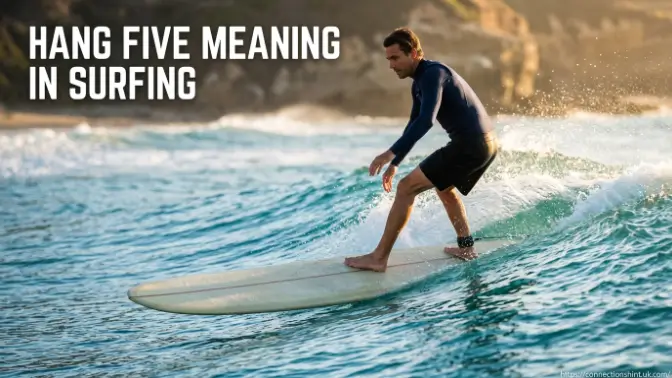
Learning Hang Five requires patience, practice, and the right combination of timing and balance. Before attempting this classic longboard surfing maneuver, surfers should become comfortable with basic board control, wave positioning, and smooth footwork. Following the steps below will help you build the confidence and technique needed to perform Hang Five safely and consistently.
Choosing the Right Wave Conditions
The success of Hang Five starts with selecting suitable waves. Small to medium-sized waves with a clean, slow-breaking face provide the best environment for practicing because they offer enough time to move toward the nose without losing balance. Gentle waves also make it easier to focus on technique instead of reacting to sudden changes in speed or direction.
Avoid attempting Hang Five in steep, fast, or choppy waves, as these conditions can make the board unstable and increase the risk of falling. As your confidence grows, you can gradually practice in more challenging conditions, but beginners should always prioritize smooth waves that support nose riding and controlled movement.
Ideal Surfboard for Hang Five
Choosing the right board is just as important as mastering the technique. A traditional longboard measuring between 8 and 10 feet is generally the best choice because it provides excellent stability, buoyancy, and control. These features make it easier to walk toward the nose while maintaining balance throughout the ride.
Many surfers also prefer longboards specifically designed for nose riding, as they often include wider noses and increased volume for better stability. Using the right equipment allows you to focus on improving your surfboard control rather than struggling to keep the board balanced.
Step 1 – Paddling and Positioning
To begin Hang Five, paddle confidently to catch a clean wave and establish a smooth ride. Once the board is gliding steadily, position yourself near the middle of the board where you have the greatest control. This stable starting point prepares you for walking toward the nose without upsetting the board’s balance.
Before moving your feet, make sure the wave is carrying you consistently, and the board feels stable beneath you. Looking ahead instead of down at your feet helps maintain proper posture and improves your awareness of the wave balance throughout the maneuver.
Step 2 – Walking to the Nose
When the board is trimming smoothly across the wave, begin walking toward the front using slow, controlled cross-steps. Cross-stepping keeps your body centered over the board and minimizes unnecessary movement that could disturb your balance. Smooth footwork is one of the defining characteristics of skilled longboard surfing.
Avoid taking large or rushed steps because sudden movements can shift your weight too quickly and cause the board to lose stability. Keep your knees slightly bent and your upper body relaxed while moving toward the nose, allowing the board to continue flowing naturally with the wave.
Step 3 – Foot Placement and Balance
Once you reach the front of the board, carefully position one foot so that all five toes extend beyond the nose, completing the Hang Five position. Your back foot should remain firmly planted behind you to maintain control, while your arms extend naturally to help with balance.
Keeping your weight evenly distributed is essential for maintaining stability during nose riding. Leaning too far forward can cause the nose to dive into the water, while shifting too much weight backward may pull the board away from the ideal position. Relaxed posture and steady breathing will help you stay balanced for longer.
Step 4 – Holding the Position
After achieving Hang Five, focus on remaining calm and letting the board glide naturally across the wave. Avoid making unnecessary adjustments with your feet, and instead use subtle arm and body movements to maintain balance. Staying relaxed allows the board to continue trimming efficiently while you hold the maneuver.
As the wave begins to lose power or your balance changes, smoothly walk back toward the center of the board using controlled cross-steps. Returning gradually helps preserve stability and prepares you to transition into your next maneuver. With regular practice and improved surf technique, you’ll be able to hold Hang Five longer and with greater confidence.
Essential Skills Needed for Hang Five
Mastering Hang Five requires more than simply walking to the nose of a surfboard. It demands a combination of physical ability, technical knowledge, and mental confidence. Developing these core skills will help you perform the maneuver with greater control, maintain stability on the wave, and progress faster in longboard surfing.
Balance and Core Strength
Balance is the foundation of a successful Hang Five. As you move toward the front of the board, your center of gravity changes, making it essential to maintain stability through strong core muscles. Exercises such as planks, yoga, balance board training, and single-leg workouts can significantly improve your ability to stay steady while riding.
Core strength also helps absorb the movement of the wave and keeps your posture controlled throughout the maneuver. A strong midsection allows you to make small body adjustments without losing balance, which is critical for nose riding and executing smooth transitions on a longboard.
Longboard Control Skills
Before attempting Hang Five, surfers should feel comfortable controlling a longboard in various wave conditions. This includes understanding how to trim the board, shift weight effectively, and make subtle adjustments to maintain speed and direction. Strong surfboard control creates a stable platform for walking toward the nose with confidence.
Developing longboard control takes regular practice and patience. Spending time improving basic maneuvers, such as smooth turns and controlled trimming, builds the experience needed to perform Hang Five successfully. The more familiar you become with your board’s behavior, the easier it is to maintain stability throughout the maneuver.
Wave Reading Ability
Reading waves is a skill that separates experienced surfers from beginners. To perform Hang Five, you must recognize waves that offer a long, clean face with enough power to support longboard surfing. Choosing the right section of the wave gives you sufficient time to walk forward without rushing your movements.
Understanding how waves break also helps you anticipate changes in speed and direction. By positioning yourself correctly and reacting to the wave’s energy, you can maintain better wave control while holding Hang Five for a longer period. Practicing wave observation before paddling out will improve your overall surfing performance.
Confidence on the Nose
Confidence plays a major role in performing Hang Five successfully. Many surfers hesitate when approaching the nose because they fear falling or losing control. However, trusting your technique and making smooth, deliberate movements will greatly improve your chances of completing the maneuver.
Building confidence comes through consistent practice in safe conditions. Start on smaller, slower waves and gradually challenge yourself as your skills improve. With experience, you’ll become more comfortable standing at the front of the board, allowing you to perform Hang Five with greater style, precision, and confidence while enjoying the true spirit of classic surfing.
Common Mistakes While Doing Hang Five
Even experienced surfers can make mistakes while attempting Hang Five, especially when learning the technique. Small errors in balance, timing, or wave selection can prevent you from holding the position or even cause you to fall off the board. Understanding these common mistakes will help you improve your longboard surfing skills, build confidence, and perform Hang Five more smoothly and consistently.
- Choosing the wrong wave instead of practicing on slow, clean waves that are ideal for nose riding.
- Using a shortboard rather than a stable longboard designed for Hang Five.
- Walking to the nose too quickly, which shifts your weight abruptly and reduces surfboard control.
- Looking down at your feet instead of keeping your eyes focused ahead to maintain balance.
- Standing with stiff knee,mmakesit harder to absorb the movement of the wave.
- Leaning too far forward, causing the nose of the board to dive into the water.
- Keeping too much weight on the back footprpreventsou from reaching the correct Hang Five position.
- Ignoring proper foot placement results in poor balance and unstable posture.
- Attempting the maneuver before mastering basic longboard skills, which often leads to frustration and repeated falls.
- Panicking when the board becomes unstable, instead of making calm, controlled body adjustments to regain wave control.
Hang Five vs Hang Ten: Key Differences
Although Hang Five and Hang Ten are both classic longboard surfing maneuvers, they differ significantly in technique, difficulty, and execution. Both involve nose riding, but Hang Five requires one foot on the nose with five toes hanging over the edge, while Hang Ten takes the challenge further by placing both feet on the nose. Understanding these differences will help surfers progress at the right pace and choose the maneuver that matches their current skill level.
Foot Position Comparison
The most noticeable difference between Hang Five and Hang Ten is foot placement. In Hang Five, the surfer places one foot at the very front of the longboard so that all five toes extend over the nose, while the back foot remains farther behind to provide balance and control. This position offers greater stability, making it the first nose riding maneuver that many longboarders learn.
In contrast, Hang Ten requires both feet to move onto the nose of the surfboard with all ten toes hanging over the edge. Because there is no rear foot supporting the rider, maintaining balance becomes much more difficult. This advanced position demands exceptional surfboard control, precise timing, and confidence.
Difficulty Level Differences
For most surfers, Hang Five is considered an intermediate maneuver because it introduces the fundamentals of walking to the nose while still allowing one foot to stabilize the board. It helps surfers develop the balance, timing, and posture needed before progressing to more advanced longboard surfing techniques.
Hang Ten is significantly more challenging because both feet are positioned at the front of the board, leaving little room for error. Blog Surfers must have excellent wave control, strong core stability, and a deep understanding of wave dynamics to hold the position successfully. It is often regarded as one of the highest achievements in traditional longboarding.
Style and Surfboard Requirements
Both Hang Five and Hang Ten are admired for their graceful appearance and smooth flow across the wave. They are signature maneuvers in classic surfing and showcase a surfer’s ability to combine balance with elegance rather than relying on aggressive turns or aerial tricks. Successfully performing either maneuver demonstrates advanced skill and confidence.
The ideal equipment for both techniques is a stable longboard with enough length, width, and volume to support nose riding. However, Hang Ten generally requires an even more specialized board and cleaner wave conditions than Hang Five. Beginners are encouraged to master Hang Five first before attempting Hang Ten, as it provides the essential foundation for progressing to more advanced longboarding skills.
Pro Tips to Master Hang Five
Mastering Hang Five takes consistent practice, patience, and attention to proper technique. While learning the maneuver can be challenging, following proven strategies will help you improve your balance, timing, and confidence on the board. By focusing on the fundamentals of longboard surfing and avoiding rushed progression, you can perform Hang Five more smoothly and with greater control.
- Practice on small, clean waves that provide enough time to move confidently toward the nose.
- Use a quality longboard designed for nose riding to improve stability and balance.
- Master cross-stepping before attempting Hang Five, as smooth footwork is essential.
- Keep your knees slightly bent to absorb the movement of the wave and maintain control.
- Focus on the horizon instead of looking down at your feet to improve overall balance.
- Strengthen your core muscles through exercises like planks, yoga, and balance board training.
- Stay relaxed while moving, as stiff body movements can reduce surfboard control.
- Watch experienced longboard surfers to learn proper timing, posture, and technique.
- Practice consistently in different wave conditions to build confidence and improve wave control.
- Be patient with your progress, because mastering Hang Five is a skill that develops through repetition and experience.
Surf Culture and History of Hang Five
Hang Five is more than just a surfing maneuver it is a symbol of tradition, style, and the timeless spirit of longboard surfing. Originating during the golden era of surfing in the 1950s and 1960s, the maneuver became a hallmark of classic surfing as riders focused on smooth, graceful movements rather than aggressive tricks. Today, Hang Five continues to represent the art of nose riding, inspiring surfers around the world to preserve the elegance and heritage of traditional longboarding.
- Hang Five originated during the golden age of longboard surfing in the 1950s and 1960s.
- The maneuver gets its name from the five toes of one foot hanging over the nose of the surfboard.
- It became a signature move of classic surfing, emphasizing style, balance, and flow.
- Legendary longboard surfers helped popularize Hang Five through competitions and surf films.
- The maneuver is closely associated with the art of nose riding, one of the defining skills of traditional longboarding.
- Hang Five remains an important judging criterion in many longboard surfing competitions.
- Modern surfers continue to practice Hang Five as a way to honor surfing’s rich history and traditions.
- The maneuver symbolizes patience, precision, and excellent wave control rather than speed or aggressive performance.
- Surf schools often teach Hang Five as a milestone for surfers progressing beyond basic longboarding techniques.
- Despite the evolution of modern surfing, Hang Five remains one of the most respected and iconic maneuvers in surf culture worldwide.
Frequently Asked Questions
What is Hang Five in surfing?
Hang Five is a classic longboard surfing maneuver in which a surfer places one foot at the front of the board with all five toes extending over the nose while riding a wave. It is one of the most popular nose riding techniques and showcases balance, control, and style.
Is Hang Five difficult for beginners?
Yes, Hang Five can be challenging for beginners because it requires good balance, proper timing, and confidence. However, with regular practice, the right longboard, and experience in surf technique, most surfers can gradually learn this maneuver.
What type of surfboard is best for Hang Five?
A traditional longboard measuring between 8 and 10 feet is the best choice for Hang Five. Boards designed for nose riding provide better stability, making it easier to walk toward the nose and maintain balance during the maneuver.
What is the difference between Hang Five and Hang Ten?
The main difference is foot placement. In Hang Five, only one foot extends over the nose with five toes hanging off the edge, while Hang Ten requires both feet to be placed on the nose with all ten toes hanging over. Hang Ten is considered a more advanced longboard surfing maneuver.
How long does it take to learn Hang Five?
The time needed to master Hang Five varies depending on your surfing experience, balance, and practice routine. Some surfers learn the basics within a few weeks, while others may need several months of consistent practice to perform the maneuver confidently in different wave conditions.
Conclusion
Hang Five is one of the most iconic and rewarding maneuvers in longboard surfing, combining balance, precision, and timeless style. Whether you’re just beginning your surfing journey or looking to improve your nose riding skills, mastering Hang Five is an important milestone that reflects both technical ability and confidence on the waves.
By practicing in suitable wave conditions, using the right longboard, and consistently improving your surf technique, you can gradually perform Hang Five with greater control and ease. Remember that progress takes time, so stay patient, keep refining your skills, and enjoy every session as you work toward becoming a more confident and accomplished longboard surfer.