
Welcome to connectionshint. Many people search for ofcourse because they are unsure whether it is the correct way to write the phrase in English. This confusion is very common among students, professionals, and English learners because the phrase is often spoken quickly in everyday conversations. When people hear it in speech, it can sound like a single word, leading them to believe that ofcourse is acceptable. However, using the wrong spelling can create mistakes in emails, academic assignments, business documents, and online content. Understanding the difference between ofcourse and “of course” is important for anyone who wants to improve their writing skills and communicate clearly in English.
The correct form is, of course, written as two separate words. It is a widely used expression that means “certainly,” “naturally,” or “without a doubt.” While ofcourse may frequently appear in informal online writing, it is not recognized as a correct English word by dictionaries or grammar guides. Learning the proper usage of of course can help you write more professionally, avoid common spelling mistakes, and increase your confidence in both formal and informal communication. In this article, you will learn the meaning of the phrase, grammar rules, practical examples, common errors, and useful tips to ensure you always use of course correctly.
What Does Of Course Mean?
The phrase of course is a common expression in English that is used to show certainty, agreement, permission, or something that is naturally expected. People use it in everyday conversations, professional communication, academic writing, and online discussions to express confidence in what they are saying. When someone responds with of course, they are usually indicating that the answer is obvious, certain, or given without hesitation. Although many people mistakenly write ofcourse, the correct form is always of course with two separate words. Understanding its meaning and proper usage can help improve writing accuracy and communication skills.
Definition of Of Course
Of course means “certainly,” “naturally,” “without a doubt,” or “yes.” It is often used when answering questions, agreeing with someone, or emphasizing that something is expected. For example, if a friend asks, “Can you help me?” you might respond, “Of course,” to show willingness and confidence. The phrase makes conversations sound polite, friendly, and reassuring while clearly expressing agreement or certainty.
Because of its simple meaning, of course is used in many different situations. It can appear in casual conversations, business emails, classroom discussions, and professional meetings. The phrase helps speakers and writers communicate their thoughts clearly while making their responses sound natural and confident. This flexibility is one reason why of course remains one of the most frequently used expressions in English.
Origin of the Phrase
The phrase of course has a long history in the English language. The word “course” originally referred to a path, route, direction, or the natural progression of events. When combined with the word “of,” the phrase suggested that something happened according to its expected path or natural order. Over time, English speakers began using the expression to indicate that a particular outcome was obvious or expected.
As the language evolved, the phrase became a standard way of expressing certainty and agreement. Today, people rarely think about its historical meaning and instead use it naturally in daily communication. Despite changes in language over the centuries, of course has remained a widely accepted phrase because it provides a simple and effective way to express confidence, assurance, and understanding.
Why People Commonly Write Ofcourse
Many people mistakenly write ofcourse because of the way the phrase sounds when spoken aloud. In normal conversation, the words “of” and “course” are often pronounced quickly, making them sound like a single word. This pronunciation can lead writers to believe that combining the words into ofcourse is correct, especially if they have not learned the grammar rule behind the phrase.
Another reason for this mistake is the influence of text messages, social media posts, and informal online communication, where spelling errors often go unnoticed. Since people frequently see incorrect spellings on the internet, they may assume that ofcourse is acceptable. However, dictionaries, grammar guides, and professional writing standards all confirm that the correct spelling is of course. Learning and remembering this rule helps writers avoid a common error and maintain credibility in both academic and professional writing.
Is it, of course, correct or Incorrect?
Many English learners and even native speakers sometimes wonder whether ofcourse is an acceptable spelling. The simple answer is that ofcourse is incorrect in standard English. The correct form is of course, written as two separate words. While the mistake is very common, especially in informal online communication, it is not recognized by dictionaries, grammar books, or professional writing standards. Understanding why ofcourse is incorrect can help you improve your writing and avoid errors in academic, business, and everyday communication.
The Correct Spelling
The correct spelling is of course, with a space between the words “of” and “course.” This form is accepted in all types of English writing, including essays, emails, reports, books, and professional documents. Whenever you want to express certainty, agreement, or something that is expected, you should use of course instead of ofcourse. Using the correct spelling demonstrates a strong understanding of English grammar and helps make your writing look more polished and professional.
Examples of correct usage include sentences such as “Of course I will help you with the project” and “Of course she understands the instructions.” In both examples, the phrase is written as two separate words because it functions as a fixed expression in English. No matter how often you use the phrase, the spelling should always remain of course.
Why Ofcourse Is Considered a Mistake
The spelling ofcourse is considered a mistake because it is not recognized as a valid English word. Standard dictionaries do not list ofcourse as an accepted term, and grammar experts agree that the phrase should always be written as two words. Although the phrase may sound like a single word when spoken quickly, pronunciation does not change the correct spelling. Many English phrases consist of multiple words, even when they are commonly spoken together.
Another reason ofcourse is viewed as incorrect is that it can reduce the professionalism and credibility of your writing. In academic assignments, business communication, and formal documents, spelling mistakes can leave a negative impression on readers. Using of course correctly shows attention to detail and helps ensure that your writing follows accepted language standards.
Grammar Rules Behind the Phrase
The phrase of course follows a simple grammar structure made up of two separate words. The word “of” is a preposition, while “course” is a noun. Together, they form an idiomatic expression that means “certainly,” “naturally,” or “without a doubt.” Because each word has its own grammatical function, they must remain separate when written. English grammar does not treat this phrase as a compound word, which is why combining them into ofcourse is incorrect.
Understanding the grammar behind the phrase makes it easier to remember the correct spelling. Many English expressions are formed from multiple words that work together to create a specific meaning. Just as phrases like “in fact,” “at least,” and “of interest” are written as separate words, of course should also remain separated. Following this grammar rule will help you write more accurately and confidently in all types of communication.
Read also: Expertise Explained: Meaning, Types, Importance and How to Build It
Difference Between Ofcourse and Of Course
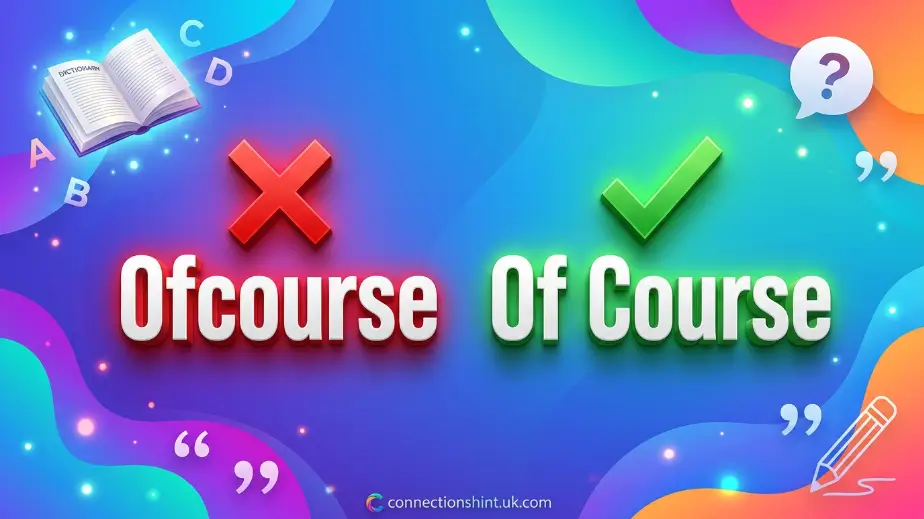
Many people become confused when deciding whether to write ofcourse or of course. The confusion usually happens because the phrase is often spoken quickly, making it sound like a single word. However, there is a significant difference between the two forms. Of course is the correct and widely accepted spelling in English, while ofcourse is considered a spelling mistake. Understanding this distinction is important because using the correct form improves the quality, accuracy, and professionalism of your writing.
Side-by-Side Comparison
The main difference between ofcourse and of course is that one is grammatically correct and the other is not. Of course is a recognized English phrase that appears in dictionaries, grammar guides, academic materials, and professional documents. It is used to express certainty, agreement, permission, or something that is naturally expected. On the other hand, ofcourse is not listed as a standard English word and is considered an incorrect spelling.
Another important difference is how each form is perceived by readers. When you write of course, your writing appears polished and grammatically correct. However, using ofcourse may create the impression that the writer is unfamiliar with standard English spelling rules. This can affect credibility, especially in formal situations such as school assignments, business emails, reports, and professional correspondence.
Which Form Should You Use?
You should always use of course in every type of writing and communication. Whether you are writing an essay, sending an email, creating online content, or participating in a conversation, of course is the correct choice. It follows standard grammar rules and is accepted by educational institutions, employers, editors, and language experts around the world.
Using of course consistently helps improve writing accuracy and demonstrates attention to detail. Since ofcourse is not recognized as a correct English word, there is no situation in which it should be preferred over of course. By remembering that the phrase consists of two separate words, you can avoid a common spelling mistake and communicate more effectively.
Quick Reference Table
The table below provides a simple comparison between ofcourse and of course to help you remember the correct usage.
| Feature | Ofcourse | Of Course |
| Correct English Spelling | No | Yes |
| Found in Dictionaries | No | Yes |
| Accepted in Academic Writing | No | Yes |
| Suitable for Professional Use | No | Yes |
| Grammatically Correct | No | Yes |
| Recommended for Everyday Writing | No | Yes |
| Commonly Used Expression | No | Yes |
This quick comparison clearly shows that of course is the only correct form. Whenever you are unsure, remember that the phrase should always be written as two separate words to follow proper English grammar and spelling rules.
How to Use Of Course Correctly in Sentences
Using of course correctly in sentences is important for clear and natural English communication. This phrase is widely used in speaking and writing to show agreement, certainty, or a positive response. When used properly, it makes your sentences sound polite, confident, and grammatically correct. However, many learners mistakenly write ofcourse, which should always be avoided. Understanding how to use of course in different situations will help you improve both fluency and writing accuracy.
In Everyday Conversations
In daily life, of course is commonly used in casual conversations to express agreement or willingness. It helps make responses sound friendly and natural. People often use it when they want to say “yes” politely and confidently.
For example, you might say:
- Of course, I will help you with your homework.
- Of course,,e you can sit here.
- Of course,s,e I remember you.
In these examples, of course, shows a positive and natural response. It makes conversations smooth and easy while clearly agreeing without confusion.
In Academic Writing
In academic writing, of course is used more carefully because the tone is more formal. It is usually included when explaining something that is generally accepted or obvious in context. However, it should not be overused, as academic writing often prefers more formal alternatives like “certainly” or “clearly.”
Examples include:
- Of course, regular practice improves language skills.
- Of course, further research is required to confirm the results.
In these sentences, of course is used to emphasize a logical or expected idea. It helps connect reasoning while keeping the writing understandable.
In Professional Communication
In professional settings such as emails, meetings, and reports, of course is used to show cooperation, confidence, and politeness. It helps maintain a respectful tone while confirming requests or agreements.
For example:
- Of course, we will send the report by tomorrow.
- Of course, we are happy to assist you.
- Of course, your feedback is important to us.
Using of course in professional communication shows that you are helpful and responsive, which builds trust and positive relationships in the workplace.
In Questions and Answers
Of course is very common in question-and-answer situations. It is often used to give a quick and positive reply, especially when the answer is obvious or expected.
Examples:
- Can you help me?
Of course, I can help you. - Will the meeting continue tomorrow?
Of course, it will. - Do you understand the instructions?
Of course, I do.
In these examples, of course makes the response clear, confident, and polite. It is one of the most natural ways to answer questions in English.
Examples of Of Course in Real Life
The phrase of course is widely used in real-life communication because it helps people respond politely, confidently, and clearly. It can be used in many different situations, from casual talking with friends to professional and academic settings. Understanding real-life examples of of course helps learners use it naturally and correctly in their own sentences. Below are different situations where this phrase is commonly used in daily English communication.
Casual Speaking Examples
In everyday conversations, of course is used to show friendliness, agreement, or willingness. It makes replies sound natural and easy-going. People often use it when talking to friends, family, or acquaintances.
For example:
- Of course I’ll come to your birthday party.
- Of course you can borrow my phone.
- Of course I remember our trip.
In these sentences, of course shows a positive response. It makes communication smooth and helps express certainty simply and politely during casual conversations.
Workplace Examples
In professional environments, of course is used to show cooperation, responsibility, and confidence. It is often included in discussions, meetings, and responses to requests.
For example:
- Of course, I will complete the task before the deadline.
- Of course, we can arrange a meeting for next week.
- Of course, I will review your document.
These examples show how of course helps maintain a polite and professional tone in the workplace. It also shows that the speaker is willing and confident in handling responsibilities.
Email Writing Examples
In emails, of course is commonly used to respond to requests or confirm information politely and professionally. It helps create a respectful and helpful tone in written communication.
For example:
- Of course, I will send you the required information today.
- Of course, we are happy to assist you with your inquiry.
- Of course, please feel free to contact us anytime.
In email writing, of course is useful for building positive communication and showing readiness to help the reader. It keeps the message polite and clear.
Educational Examples
In educational settings, such as classrooms or assignments, of course is used by teachers and students to explain ideas or respond to questions confidently. It helps make explanations simple and understandable.
For example:
- Of course, practice improves your writing skills.
- Of course, reading regularly increases vocabulary.
- Of course, understanding grammar is important for learning English.
These examples show how of course is used to support learning and explain concepts clearly. It helps students understand that certain ideas are naturally true or commonly accepted.
Common Mistakes People Make with Ofcourse
Many English learners and even native speakers often make mistakes when using ofcourse instead of the correct form of course. These errors usually happen due to fast speech, lack of grammar awareness, or overuse in informal writing. Understanding these common mistakes helps improve writing accuracy and ensures clearer communication in both formal and informal situations.
Writing It as One Word
The most common mistake is writing ofcourse as a single word. This happens because in spoken English, the phrase is often said quickly, making it sound like one word. However, in correct written English, it should always be written as two separate words: of course.
For example, many people wrongly write:
- I will help you, of course.
The correct form is:
- I will help you, of course.
This small spacing error can affect the professionalism of your writing, especially in academic and business communication.
Overusing the Phrase
Another common mistake is using of course too frequently in writing or speech. While it is a useful phrase, repeating it many times can make your communication sound repetitive and less natural.
For example:
- Of course I agree. Of course, I will help. Of cours,e I understand.
Instead, it is better to vary your language using alternatives such as “certainly,” “definitely,” or “sure.” This makes your writing more engaging and balanced.
Using It in Formal Situations Incorrectly
Although of course is grammatically correct, it is sometimes overused in very formal writing, where a more neutral tone is preferred. In academic papers, reports, or official documents, using too many conversational phrases can reduce formality.
For example:
- Of course, the results clearly show improvement.
In more formal writing, it may be better to use:
- Clearly, the results show improvement.
Choosing the right tone is important for maintaining professionalism in writing.
Confusing It with Similar Expressions
Some learners confuse of course with similar words like “certainly,” “naturally,” or “obviously.” While these words have similar meanings, they are not always interchangeable in every context.
For example:
- Of course, I will come. (polite agreement)
- Obviously, I will come. (stronger and sometimes more direct tone)
Using the wrong expression can change the tone of your sentence. That is why it is important to understand the subtle differences between these phrases before using them in writing or speech.
Similar Words and Phrases to Of Course
The phrase of course is commonly used in English to show agreement, certainty, or a positive response. However, several other words and expressions can be used in similar situations. Learning these alternatives helps you avoid repetition and makes your communication more natural and flexible. Each expression has a slightly different tone, so it is important to understand when and how to use them correctly.
Certainly
Certainly is a formal and polite way to show strong agreement or confirmation. It is often used in professional communication, customer service, and academic writing. It gives a respectful and confident tone to your response.
For example:
- Certainly, I will send you the report.
- Certainly, we can arrange a meeting.
This word is very useful when you want to sound professional and clear.
Naturally
Naturally is used to express something that is expected or obvious. It suggests that the situation is normal or logical without needing extra explanation. It is often used in both spoken and written English.
For example:
- Naturally, she was happy with the result.
- Naturally, we support your decision.
This phrase helps show that something happens in a normal way.
Definitely
It is definitely used to express strong certainty or complete agreement. It is commonly used in both casual and professional communication. It makes your response sound confident and clear.
For example:
- I will definitely attend the meeting.
- Definitely, that is a great idea.
This word is very direct and strong, so it is useful when you want to emphasize certainty.
Without a Doubt
Without a doubt is a strong expression used to show complete confidence in a statement. It is slightly more formal and is often used in writing or speeches.
For example:
- Without a doubt, he is the best candidate.
- Without a doubt, this is the right decision.
It is useful when you want to strongly emphasize belief or certainty.
Sure
Sure is a simple and informal alternative to of course. It is commonly used in everyday conversations when agreeing with someone or accepting a request.
For example:
- Sure, I can help you.
- Sure, let’s go together.
This word is very casual and is best used in friendly or informal situations.
Tips to Remember the Correct Usage of Of Course
Remembering the correct usage of of course is important because many learners mistakenly write it as ofcourse. This small spelling error is very common, but it can easily be avoided with the right learning techniques. By using simple memory tricks, regular writing practice, and strong proofreading habits, you can quickly master the correct form and use it confidently in all types of writing.
Easy Memory Tricks
One of the simplest ways to remember the correct form is to break it into two clear words: “of” and “course.” Always remind yourself that both words have their own meaning and should never be combined. A helpful trick is to think of similar phrases like “of interest” or “of value,” which are also written as separate words.
Another useful memory method is to say the phrase slowly while focusing on the space between the words. Blog Training your brain to recognize of course as two separate parts helps reduce spelling mistakes over time. You can also repeat a simple rule: “Never write of course, always write of course.”
Writing Practice Methods
Regular writing practice is one of the best ways to master correct usage. Try writing sentences every day using of course in different contexts, such as conversations, emails, or short paragraphs. The more you use it, the more natural it will feel.
You can also create practice exercises for yourself, such as rewriting incorrect sentences by fixing ofcourse to of course. Flashcards, writing drills, and grammar exercises can help reinforce correct spelling and improve long-term memory.
Reading and Proofreading Habits
Reading English books, articles, and professional content helps you naturally absorb correct spelling patterns. When you frequently see of course written correctly, your brain starts to recognize it as the standard form.
Proofreading is also very important. Before submitting any writing, always check for common mistakes, like of course. Taking a few extra seconds to review your work can greatly improve accuracy and professionalism. Over time, this habit will help you write more confidently and avoid simple grammar errors.
Quick Comparison Table
Understanding the difference between Ofcourse and Of Course is very important for correct English writing. Many learners get confused between these two forms, but only one is grammatically correct. The table below clearly shows how Ofcourse is incorrect while Of Course is the proper and accepted form in all types of writing.
Ofcourse vs Of Course
| Feature | Ofcourse | Of Course |
| Correct English | No | Yes |
| Dictionary Entry | No | Yes |
| Formal Writing | Incorrect | Correct |
| Academic Use | Incorrect | Correct |
| Everyday Use | Incorrect | Correct |
This comparison makes it clear that Of Course should always be used in writing, while Ofcourse should be avoided in all situations because it is not considered standard English.
Why Correct Spelling Matters in Writing
Correct spelling is an essential part of effective English writing because it directly affects clarity, understanding, and overall impression. Using the correct form of course instead ofof coursee may look like a small detail, but in reality, it plays a big role in how your writing is received. Good spelling shows that the writer has strong language skills and pays attention to detail, which is important in academic, professional, and everyday communication.
Academic Importance
In academic writing, spelling accuracy is very important because it is part of how students are evaluated. Teachers and examiners not only look at ideas, but also at how correctly those ideas are written. If a student uses incorrect spelling, like ofcourse, it can make the writing look careless and less professional, which may affect the overall marks.
When students use the course correctly, it shows that they understand grammar rules and can apply them properly. It also makes their writing clearer and more formal. Correct spelling improves the quality of essays, assignments, and research work because the reader can focus on the meaning without being distracted by mistakes.
Professional Credibility
In professional environments, correct spelling is very important because it reflects your communication skills and attention to detail. Business emails, reports, and official documents are expected to be clear, accurate, and free from mistakes. If someone uses ofcourse instead of of course, it can give the impression that the writer is careless or not familiar with standard English rules, even if the overall message is understandable.
Using the correct form of course helps create a positive impression and builds trust with colleagues, clients, and employers. It shows that the writer values accuracy and professionalism in communication. This small detail can improve credibility and support career growth because strong writing skills are often linked with reliability and competence in the workplace.
Better Communication
Correct spelling is important in communication because it directly affects how clearly your message is understood. When words are written correctly, the reader can focus on the meaning instead of stopping to think about mistakes. This makes the communication smoother, faster, and more effective.
Usinaf course correctly is a simple example of this. It helps your writing sound natural, clear, and professional. It also prevents confusion that may happen when incorrect forms like ofcourse are used. Overall, good spelling improves your writing quality and builds confidence in all types of communication.
Frequently Asked Questions
Is it one word or two words?
Ofcourse is incorrect. The correct form is of course, written as two separate words. It is a standard English phrase used to show agreement or certainty.
Why do people write, of course
People often write of course because they speak the phrase quickly, making it sound like one word. It is also a common mistake in informal texting and online writing.
Can I use ofcourse in formal writing?
No, ofcourse should not be used in formal writing. The correct and accepted form is, of course, which is suitable for academic, professional, and business communicationIs it, s of course g,rammatically correct?
Yes, of course is grammatically correct. It is a common English phrase used to express certainty, agreement, or something expected.
What words can replace of course?
You can use alternatives such as “certainly,” “definitely,” “naturally,” “sure,” or “without a doubt,” depending on the context and tone of your sentence.
Conclusion
The main idea is that the correct form is always of course, not ofcourse, even though many people mistakenly write it as one word. This mistake usually happens because the phrase is spoken quickly in daily conversation, but in proper English writing, grammar rules clearly require it to be written as two separate words. This small spelling detail may look simple, but it has a big impact on how clear, correct, and professional your writing appears.
Using the course correctly is important because it improves the quality of your communication in all areas, including studies, work, and daily conversation. It helps you avoid common spelling mistakes, strengthens your grammar skills, and makes your writing easier to understand. When you consistently use correct forms, your English becomes more polished, confident, and effective in every situation.