
Welcome to Connectionshint. Learning the meaning of possibly is important because it is a common word used in everyday English. You may hear it in conversations, read it in books, or see it in emails and articles. The word possibly is used when something is not certain but has a chance of happening. It helps speakers and writers express doubt, uncertainty, or possibility politely and naturally. Understanding how to use possibly correctly can make your English sound more fluent and professional.
In this complete guide, you will learn everything you need to know about possibly in simple and easy English. We will explain its meaning, grammar rules, sentence structure, and real-life examples that are easy to understand. You will also discover common synonyms, learn the difference between possibly, maybe, and perhaps, and avoid common mistakes. By the end of this guide, you will be able to use possibly confidently in both speaking and writing.
How to Use Possibly in Sentences
Using possibly correctly in sentences is an important part of learning English. This word helps you express uncertainty, possibility, or polite requests without sounding too direct. You can use possibly in both spoken and written English, making it a valuable addition to your English vocabulary. Once you understand its placement and usage, you will be able to create natural and grammatically correct sentences with confidence.
Basic Sentence Structure
The most common way to use possibly is before the main verb or after a modal verb such as may, might, could, can, or would. Placing possibly in the correct position makes your sentence sound natural and easy to understand. It is often used when discussing events that may happen in the future or situations that are uncertain.
Here are a few examples:
- She may possibly arrive late.
- We could possibly solve the problem together.
- They might possibly visit us next week.
- This is possibly the best solution.
Learning these sentence patterns will improve your English grammar and help you use possibly correctly in everyday communication.
Everyday Conversation Examples
In daily conversations, possibly is often used when you are unsure about something or when you want to sound polite. It allows you to express uncertainty without making a definite statement. Native English speakers frequently use possibly in casual discussions, questions, and polite requests.
For example, you might say, “I will possibly finish my homework tonight,” or “Could you possibly help me carry these bags?” You can also say, “She is possibly at the library,” if you are not certain about her location. Using possibly in these situations makes your English speaking skills sound more natural and confident.
Formal Writing Examples
In formal writing, possibly is used to present ideas carefully without making absolute claims. It is common in business reports, academic papers, professional emails, and research articles because it shows that a statement is based on possibility rather than certainty. This makes your writing sound balanced, objective, and professional.
For example, a business report might say, “The new strategy could possibly increase customer satisfaction.” In an academic paper, you could write, “The results possibly indicate a relationship between the two variables.” Similarly, a professional email might include the sentence, “Could you possibly review this document before the meeting?” Using possibly in formal contexts strengthens your writing skills and helps you communicate with clarity and professionalism.
Grammar Rules for Using Possibly
Learning the grammar rules for possibly is important because it helps you use the word correctly in different types of sentences. Since possibly is an adverb, it can appear in different positions depending on the sentence structure and the verb being used. Understanding these grammar rules will improve your English grammar, make your sentences more natural, and help you communicate your ideas with confidence in both spoken and written English.
Position in a Sentence
The position of possibly in a sentence depends on the type of verb and the meaning you want to express. In most cases, possibly is placed after a modal verb such as may, might, could, or can. It can also be placed before the main verb or before an adjective to show that something is uncertain or has a chance of being true. Using the correct position makes your sentences sound clear and grammatically correct.
For example, you can say, “She may possibly arrive tomorrow,” or “We could possibly complete the project this week.” It is also correct to write, “This is possibly the best option,” where possibly modifies the adjective. Learning the correct placement of possibly improves your sentence structure and helps you avoid common grammar mistakes.
Using Possibly with Modal Verbs
One of the most common ways to use possibly is with modal verbs because both work together to express possibility or uncertainty. Modal verbs such as can, could, may, might, and would are frequently followed by possibly to make the meaning more natural and polite. This combination is common in everyday conversations, business communication, and academic writing.
For instance, you can say, “They might possibly join us later,” or “We could possibly find a better solution.” In polite requests, sentences like “Could you possibly help me?” or “Would you possibly send the document today?” sound more respectful than direct requests. Using possibly with modal verbs strengthens your English vocabulary and helps you express ideas more accurately.
Common Grammar Patterns
Several grammar patterns include possibly, and practicing them will help you become more confident in English. The most common pattern is Subject + Modal Verb + possibly + Main Verb, but possibly can also appear before the main verb or before an adjective, depending on the sentence. These patterns are widely used by native English speakers because they sound smooth and natural.
Here are some common examples: “She may possibly call this evening,” “He possibly forgot the meeting,” “Could you possibly explain this topic again?” and “This is possibly the easiest way to solve the problem.” By practicing these sentence structures, you will improve your English speaking skills, write more naturally, and use possibly correctly in both formal and informal situations.
Read also: Crosswordle Guide: How to Play, Rules, Tips & Winning Strategies
Examples of Possibly
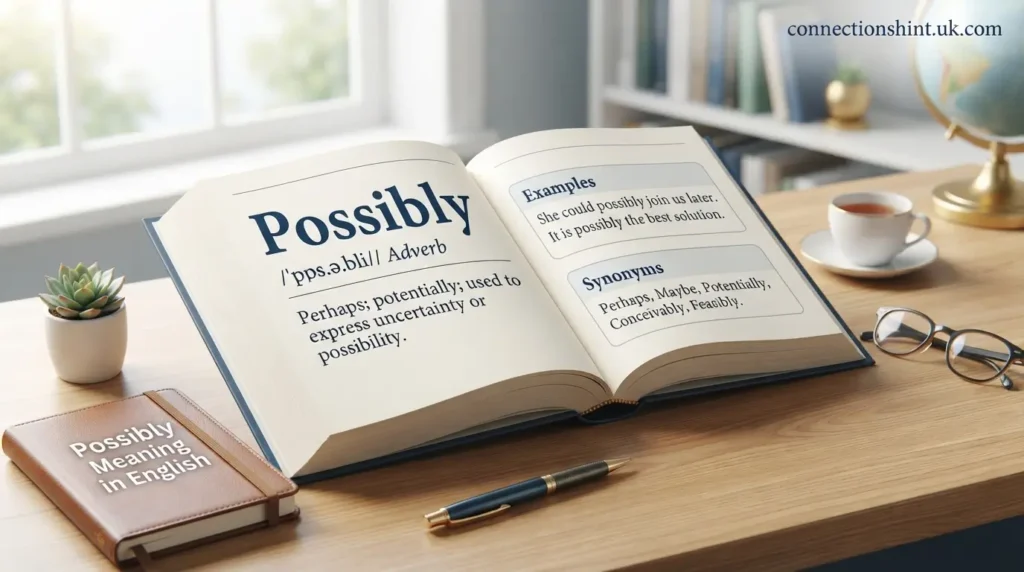
Learning through examples is one of the best ways to understand how possibly is used in English. By reading different sentence types, you can see how possibly expresses uncertainty, possibility, or polite communication in real situations. Practicing these examples will improve your English vocabulary, strengthen your writing, and help you use possibly naturally in everyday conversations.
Positive Sentences
Positive sentences may possibly describe situations that may happen or may be true without expressing complete certainty. They are commonly used when there is a chance of something happening in the future or when the speaker wants to avoid making a definite statement. These sentences sound polite, natural, and grammatically correct.
Here are some positive examples:
- She will possibly visit us next weekend.
- We could possibly finish the project today.
- They may possibly win the competition.
- This is possibly the best restaurant in town.
- He is possibly the right person for the job.
Practicing these examples will improve your English speaking skills and help you use possibly confidently in everyday communication.
Negative Sentences
Negative sentences with possibly are used when talking about things that are unlikely or cannot happen. In many cases, possibly appears with words like “cannot” or “can’t” to emphasize that something is impossible or very unlikely. This structure is commonly used in both spoken and written English.
Examples of negative sentences include:
- I can’t possibly finish all this work today.
- She couldn’t possibly know the answer without studying.
- They can’t possibly arrive on time because of the traffic.
- We couldn’t possibly ignore this important issue.
- He can’t possibly believe that story.
Using these sentence patterns correctly will strengthen your English grammar and help you express negative possibilities more naturally.
Question Sentences
Possibly is often used in questions to make requests sound more polite or to ask about uncertain situations. It is commonly placed after modal verbs such as “could” and “would,” making the question respectful and friendly. Native English speakers frequently use this pattern in formal and informal conversations.
Some common question examples are:
- Could you possibly help me with this assignment?
- Can you possibly arrive a little earlier?
- Would you possibly explain this topic again?
- Could they possibly finish the work before Friday?
- Is this possibly the correct answer?
Learning these examples will improve your communication skills and make your English sound more polite and professional.
Real-Life Examples
In everyday life, possibly appears in conversations, business meetings, emails, news reports, and academic writing. It helps people discuss uncertain situations without making absolute statements. Knowing how to use possibly in real-life contexts will make your English more fluent and natural.
For example, a teacher might say, “The exam could possibly be postponed due to bad weather.” A manager may write, “We will possibly launch the new product next month.” A friend might say, “She is possibly at the shopping mall right now.” By practicing these real-life examples, you will improve your English communication skills and become more confident when using possibly in daily conversations and professional situations.
Synonyms of Possibly
Learning the synonyms of possibly is a great way to improve your English and make your writing more varied. Although these words have similar meanings, each one is used in slightly different situations and tones. Understanding these differences will expand your English vocabulary and help you choose the most suitable word for everyday conversations, professional writing, and academic work.
Maybe
Maybe is one of the most common synonyms of possibly. It is mainly used in informal conversations when you want to express uncertainty or say that something has a chance of happening. Compared to possibly, maybe sounds more casual and is commonly heard in daily speech.
For example, you can say, “Maybe it will rain this afternoon,” or “Maybe she will come to the party.” These sentences have a similar meaning to using possibly, but they sound more relaxed. Learning when to use maybe will improve your English speaking skills and make your conversations sound more natural.
Perhaps
Perhaps is another close synonym of possibly and is often used in both formal and informal English. It has the same basic meaning but usually sounds more polite and slightly more formal than maybe. Many writers and speakers choose to do so when they want their language to sound more refined.
For example, you can write, “Perhaps we should leave early,” or “Perhaps he knows the answer.” These examples express uncertainty while maintaining a professional tone. Understanding the difference between possibly and perhaps will strengthen your English grammar and help you write more effectively.
Conceivably
Conceivably is a more advanced synonym of possibly. It is used to describe something that is imaginable or could happen, even if the chance is quite small. This word is more common in formal writing, academic discussions, and professional communication than in everyday conversations.
For instance, you might say, “The company could conceivably expand into new markets,” or “This plan could conceivably solve the problem.” Although conceivably and possibly share similar meanings, conceivably often suggests that the situation is theoretically possible. Learning this synonym will enrich your English vocabulary and improve your formal writing.
Potentially
Potentially is another useful synonym of possibly, but it focuses on future possibilities or expected outcomes. It is commonly used in business, education, science, and technology when discussing situations that could develop over time. Compared to possibly, potentially often highlights future potential rather than present uncertainty.
For example, you can say, “This investment could potentially increase your profits,” or “The new medicine could potentially save many lives.” These sentences show that something may happen in the future if certain conditions are met. Understanding how to use potentially correctly will improve your writing skills and help you communicate more precisely in professional and academic contexts.
Difference Between Possibly, Maybe, and Perhaps
Although possibly, maybe, and perhaps all express uncertainty, they are not always used in the same way. The main difference lies in their tone, grammar, and the situations where they are most appropriate. Possibly is commonly used as an adverb within a sentence to show that something may happen or be true. Maybe is more informal and is often used at the beginning of a sentence, while perhaps has a slightly more formal tone and is frequently found in professional or written English. Understanding these differences will improve your English vocabulary and help you choose the right word in every situation.
Comparison Table
| Feature | Possibly | Maybe | Perhaps |
| Meaning | There is a chance something may happen or be true. | Something may happen or be true. | Something may happen or be true. |
| Word Type | Adverb | Adverb | Adverb |
| Tone | Neutral to formal | Informal | Neutral to formal |
| Common Usage | Inside a sentence or after modal verbs | Usually, at the beginning of a sentence | At the beginning or middle of a sentence |
| Everyday Conversation | Yes | Very common | Common |
| Formal Writing | Yes | Less common | Very common |
| Example | She could possibly arrive early. | Maybe she will arrive early. | Perhaps she will arrive early. |
| Best Used For | Showing possibility politely or carefully | Casual conversations | Professional or polite writing |
Common Mistakes When Using Possibly
Although possibly is a simple English word, many learners make mistakes when using it in sentences. These errors usually happen because of incorrect word placement, confusion with similar words like maybe, or using possibly in situations where it does not fit naturally. Learning these common mistakes will improve your English grammar, strengthen your writing, and help you use possibly more confidently in everyday conversations and formal communication.
- Using possibly instead of “maybe” at the beginning of every sentence.
- Placing possibly in the wrong position within a sentence.
- Using possibly without a modal verb when one is needed.
- Confusing possibly with maybe in formal writing.
- Using possibly to express certainty instead of uncertainty.
- Repeating possibly multiple times in the same sentence unnecessarily.
- Forgetting punctuation when possibly appears in longer sentences.
- Using possibly in situations where another adverb sounds more natural.
- Creating awkward sentence structures by placing possibly too far from the verb it modifies.
- Not practicing possibly in real-life conversations, which leads to unnatural usage and reduced confidence.
Tips to Learn and Remember Possibly
Learning and remembering possibly become much easier when you practice them regularly in real-life situations. Instead of only memorizing its meaning, try using possibly while speaking, writing, reading, and listening to English every day. This practical approach will improve your English vocabulary, strengthen your confidence, and help you use the word naturally in both formal and informal communication.
- Practice using possibly in at least five new sentences every day.
- Read English books, blogs, and news articles to see how possibly is used in context.
- Listen to English podcasts, movies, or TV shows and notice when speakers use possibly.
- Compare possibly with maybe and perhaps to understand the differences in meaning and tone.
- Use possibly in everyday conversations with friends, classmates, or language partners.
- Keep a vocabulary notebook and write down new sentences that include possibly.
- Complete grammar exercises that focus on English adverbs and sentence structure.
- Try writing short paragraphs or emails using possibly in different situations.
- Review your sentences regularly to identify and correct any grammar mistakes.
- Practice consistently, as regular use is the best way to remember possibly and improve your overall English speaking skills.
Frequently Asked Questions
What does this possibly mean?
Possibly means that something may happen or may be true, but it is not certain. It is commonly used to express possibility or uncertainty in English and helps improve your English vocabulary.
How do you use possibly in a sentence?
You can use possibly after modal verbs like may, might, or could, or before the main verb in some sentences. Using it correctly improves your English grammar and makes your sentences sound more natural.
Is possibly the same as maybe?
No, possibly, and maybe have similar meanings, but maybe is more informal. Possibly is possibly suitable for both everyday conversations and formal writing, making it a useful part of your English communication skills.
Can it possibly be used in formal writing?
Yes, possibly is widely used in business emails, academic papers, and professional reports. It helps writers express ideas carefully and strengthens their writing skills.
What are the best synonyms for possibly?
Some common synonyms of possibly are maybe, perhaps, conceivably, and potentially. Learning these words expands your English vocabulary and helps you communicate more effectively.
Conclusion
Possibly is an important English adverb that helps you express uncertainty, possibility, and polite communication clearly and naturally. Whether you are speaking with friends, writing professional emails, or studying English, knowing how to use possibly correctly will make your communication more accurate and confident. Throughout this guide, you have learned the meaning of possibly, its grammar rules, sentence structure, common examples, synonyms, and the differences between possibly, maybe, and perhaps. Mastering these concepts will improve your English vocabulary, strengthen your sentence formation, and help you avoid common grammar mistakes.
Learning possibly is not just about memorizing its meaning; it is about using it confidently in real-life situations. Practice creating your own sentences, pay attention to how native English speakers use possibly, and include it in your daily conversations and writing exercises. The more you practice, the more natural your English will become. By making possibly a regular part of your English communication skills, you will be able to express ideas politely, discuss uncertain situations effectively, and communicate with greater fluency in both personal and professional settings.