
Welcome to connectionshint. Scrabble is one of the world’s most popular word board games, enjoyed by millions of players of all ages. Whether you’re playing with family, competing against friends, or participating in tournaments, Scrabble combines vocabulary, strategy, and critical thinking in a way that makes every game both entertaining and challenging. Learning the rules, understanding the scoring system, and mastering effective techniques can significantly improve your performance and increase your chances of winning.
In this comprehensive guide, you’ll discover everything you need to know about Scrabble, from its history and basic gameplay to advanced strategies used by experienced players. We’ll explain how the game works, break down letter values and premium squares, share practical tips for building high-scoring words, and highlight common mistakes to avoid. By the end of this guide, you’ll have the knowledge and confidence to enjoy Scrabble at any skill level.
What Is Scrabble?
Scrabble is a classic word board game in which two to four players create interconnected words using letter tiles on a specially designed board. Each letter carries a specific point value, and players aim to earn the highest score by forming valid words while taking advantage of premium squares. Combining vocabulary, strategy, and careful planning, Scrabble offers an engaging experience that appeals to beginners, casual players, and competitive enthusiasts alike.
History of Scrabble
The story of Scrabble began in 1938 when American architect Alfred Mosher Butts created the game during the Great Depression. Inspired by the popularity of crossword puzzles and traditional board games, he designed a game that blended word creation with strategic scoring. After several refinements and early challenges in attracting manufacturers, the game eventually gained widespread recognition and became a commercial success.
Over the decades, Scrabble has evolved into one of the world’s most recognizable strategy games. It has been translated into numerous languages, adapted for digital platforms, and embraced by schools, families, and international tournaments. Today, Scrabble continues to connect players across generations while encouraging language development, friendly competition, and lifelong learning.
Why Scrabble Remains Popular
One of the biggest reasons Scrabble has remained a favorite for decades is its unique combination of entertainment and education. Every match challenges players to expand their vocabulary, improve spelling, and think strategically while creating high-scoring words. Unlike many modern games, this vocabulary game rewards both knowledge and careful planning, making each session feel fresh and rewarding.
Another reason for the lasting success of Scrabble is its universal appeal. People of all ages can enjoy playing with family, friends, or opponents online, regardless of their experience level. The game’s simple rules, endless word combinations, and competitive depth ensure that no two matches are ever the same, helping Scrabble remain one of the most beloved word games in the world.
Read also: wwf cheat
How to Play Scrabble
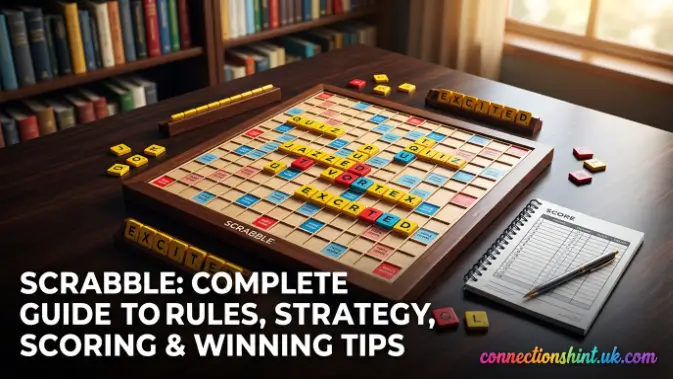
Learning how to play Scrabble is simple, but mastering the game requires practice, strategy, and a strong understanding of the rules. Players take turns placing letter tiles on the board to create connected words, earning points based on letter values and premium squares. The objective is to finish the game with the highest total score by making valid words and using available tiles wisely.
Game Components
A standard Scrabble set includes a game board, 100 letter tiles, four tile racks, a tile bag, and a score sheet for keeping track of points. Each letter tile has a specific value, with common letters such as vowels carrying fewer points and less frequently used letters like Q and Z offering much higher scores. These components work together to create an engaging word board game experience.
Before the game begins, all letter tiles are placed inside the tile bag and mixed thoroughly. Each player draws seven tiles and places them on their rack without revealing them to opponents. Throughout the game, players replenish their racks after each turn, ensuring they always have up to seven tiles available to build new words in Scrabble.
Board Layout
The Scrabble board consists of a 15×15 grid containing 225 squares, including several colored premium spaces that can significantly increase a player’s score. These special squares include double letter score, triple letter score, double word score, and triple word score, encouraging players to think strategically before placing their tiles.
The center square is marked with a star and serves as the starting point for every game of Scrabble. The first word must cover this square, and every word played afterward must connect to existing words on the board. This interconnected layout creates endless opportunities for creative word building and tactical scoring.
Tile Distribution
One of the key features of Scrabble is its carefully balanced tile distribution. The game contains 100 tiles, including letters with different frequencies and two blank tiles that can represent any letter. Common letters such as E, A, and I appear more frequently, while high-value letters like Q, X, J, and Z are limited, making them valuable strategic assets.
Understanding tile distribution helps players make smarter decisions throughout the game. Rather than focusing only on high-scoring letters, experienced Scrabble players aim to maintain a balanced rack with a healthy mix of vowels and consonants. Good tile management increases the chances of creating longer words and achieving higher scores.
Turn Sequence
Each turn in Scrabble follows a straightforward sequence. A player places one or more tiles on the board to create a valid word, announces the score, and then draws replacement tiles from the bag until their rack contains seven tiles again. If a player cannot form a suitable word, they may exchange selected tiles or choose to pass their turn, depending on the game rules being used.
As the game progresses, the available spaces on the board become more limited, making every move increasingly strategic. Successful Scrabble players carefully evaluate both offensive and defensive opportunities, looking for ways to maximize their own score while preventing opponents from taking advantage of valuable premium squares on future turns.
Scrabble Rules Explained
Understanding the official rules of Scrabble is essential for fair and enjoyable gameplay. While the game is easy to learn, following the correct game rules ensures that every player competes on equal terms. From placing words correctly to using special tiles and ending the game, knowing these rules will help you avoid mistakes and improve your overall performance.
Word Placement Rules
In Scrabble, every word placed on the board must connect to an existing word, forming a continuous network of valid words. The first word of the game must cover the center star square, and each new word must read either horizontally or vertically. Diagonal words are not allowed, and every newly formed word created during a turn must be valid according to the accepted Scrabble dictionary.
Players should carefully check that all connected words are spelled correctly before ending their turn. If a challenge system is being used, opponents may question a word they believe is invalid. Learning commonly accepted playable words and understanding official word lists can help players avoid penalties and maintain a competitive advantage during Scrabble matches.
Blank Tiles
A standard Scrabble set contains two blank tiles, which are among the most valuable strategic pieces in the game. Although blank tiles carry zero points, they can represent any letter the player chooses when placing a word. Once assigned, the blank tile keeps that letter for the remainder of the game and cannot be changed later.
Experienced players often save blank tiles until they can create longer words or earn a bonus for using all seven tiles in a single turn. Since blank tiles offer unmatched flexibility, using them at the right moment can dramatically improve scoring opportunities and increase your chances of winning this popular word game.
Premium Squares
The Scrabble board includes several premium squares designed to increase scoring potential. These special spaces include Double Letter Score (DLS), Triple Letter Score (TLS), Double Word Score (DWS), and Triple Word Score (TWS). A premium square only applies when a tile is placed on it for the first time, making strategic placement extremely important.
Successful Scrabble players plan several moves to take advantage of premium squares while preventing opponents from accessing high-value positions. Combining valuable letters with word multipliers can produce exceptionally high scores, especially when creating multiple words in a single turn or completing a seven-tile bingo.
Ending the Game
A game of Scrabble ends when all letter tiles have been drawn, and one player has used every tile from their rack, or when no further legal moves are possible. At the end of the game, each player’s remaining tiles are subtracted from their total score. If a player has emptied their rack, they also receive the total value of all remaining tiles held by their opponents.
Final scoring often changes the outcome of a close match, making endgame strategy just as important as the opening moves. Skilled Scrabble players carefully manage their letter tiles during the final rounds, aiming to finish with an empty rack while minimizing unused letters to maximize their final score.
Scrabble Letter Values and Scoring
Scoring is one of the most exciting aspects of Scrabble, as every letter and board position can influence the final result. Each tile has a specific point value based on its frequency in the English language, while scoring rules and premium squares create opportunities to earn significantly higher totals. Understanding how points are calculated allows players to make smarter decisions and maximize every turn.
Letter Point Values
Every letter in Scrabble is assigned a point value that reflects how common or rare it is in the English language. Frequently used letters such as A, E, I, O, U, L, N, R, S, and T are worth only one point because they appear often and are easier to use. Less common letters like F, H, V, W, and Y have moderate values, while rare letters such as J, X, Q, and Z offer some of the highest scores, making them especially valuable during gameplay.
Knowing the letter values helps players build stronger strategies instead of simply creating the longest possible words. Experienced Scrabble players often look for opportunities to place high-value letters on premium spaces, allowing them to score far more points than they would by focusing only on word length. Balancing high-scoring letters with common vowels and consonants is also essential for maintaining a playable rack.
Bonus Squares
The Scrabble board features several colored bonus squares that can dramatically increase a player’s score. Double Letter Score (DLS) and Triple Letter Score (TLS) multiply the value of individual letter tiles, while Double Word Score (DWS) and Triple Word Score (TWS) multiply the total score of the completed word. These bonuses apply only when a tile is placed on the square for the first time.
Using bonus squares effectively is one of the most important skills in Scrabble. Rather than making the highest-scoring move available immediately, skilled players often plan several turns to create opportunities for even larger scores. At the same time, they try to block opponents from accessing valuable word multiplier squares that could shift the game’s momentum.
Bingo Bonus
One of the biggest scoring opportunities in Scrabble is earning a bingo bonus. A bingo occurs when a player uses all seven letter tiles from their rack in a single turn to form one or more valid words. In addition to the normal score for the word and any premium square bonuses, the player receives an extra 50-point bonus.
Achieving a bingo requires careful rack management and a strong vocabulary, making it a key strategy among experienced players. Rather than using only a few tiles each turn, advanced Scrabble players often organize their racks to increase the likelihood of forming seven-letter combinations. A well-timed bingo can quickly change the outcome of a close match.
Example Score Calculation
Suppose a player forms the word “QUIZ” in Scrabble. The letters are worth Q = 10 points, U = 1 point, I = 1 point, and Z = 10 points, giving the word a base score of 22 points. If the letter Z is placed on a Triple Letter Score square, its value increases from 10 to 30 points, raising the word’s total before any word multipliers are applied.
If the same word also covers a Double Word Score square, the entire calculated score is doubled, resulting in an impressive final total. This example shows why experienced Scrabble players focus not only on creating valid words but also on placing them strategically to maximize scoring opportunities throughout the game.
Best Scrabble Strategies to Win
Winning at Scrabble requires more than just a large vocabulary. Successful players combine word knowledge with smart planning, efficient game strategy, and careful decision-making throughout every stage of the match. Whether you’re new to the game or preparing for competitive play, learning proven strategies can help you score more points, control the board, and consistently outperform your opponents.
Beginner Tips
If you’re new to Scrabble, start by focusing on creating simple words while learning the basic rules and scoring system. Instead of searching only for long words, try making shorter words that connect with existing ones on the board. This approach helps you earn steady points and builds confidence as you become familiar with the word game.
Another helpful tip is to keep a balanced mix of vowels and consonants on your tile rack. Avoid holding too many high-value letters if you cannot use them effectively. As you gain experience, you’ll recognize common word patterns and improve your ability to create higher-scoring plays in Scrabble.
Intermediate Strategies
Once you’ve mastered the basics, it’s time to think several moves ahead in Scrabble. Rather than choosing the highest-scoring word available on every turn, consider how your move will affect future opportunities. Position your words to access premium squares while limiting your opponent’s chances to earn bonus points. This type of strategic thinking often makes a significant difference during close matches.
Expanding your vocabulary with two-letter and three-letter words is another effective strategy. These small but powerful words allow you to fit tiles into tight spaces, create multiple words in one turn, and take advantage of premium squares. Regular practice and studying official word lists will greatly improve your performance.
Advanced Tournament Techniques
Competitive Scrabble players rely on advanced techniques that go beyond everyday gameplay. One of the most effective methods is memorizing common word stems and letter combinations that can quickly form seven-letter words. This increases the chances of earning the valuable bingo bonus and achieving consistently high scores throughout a match.
Tournament players also analyze the remaining tiles after every turn to estimate which letters are still available. This technique, known as tile tracking, helps them predict their opponents’ possible moves and make smarter decisions. Combined with excellent vocabulary and board awareness, these advanced skills provide a strong advantage in high-level Scrabble competitions.
Rack Management
Good rack management is one of the most important skills in Scrabble. Instead of focusing only on immediate scoring opportunities, players should maintain a balanced selection of letters that allows for flexible word creation in future turns. Keeping a healthy combination of vowels and consonants improves the chances of building longer and more valuable words.
Experienced players also avoid holding difficult letters like Q, J, X, or Z for too long unless they have a clear plan to use them. Exchanging poor tile combinations when necessary is often a smarter choice than forcing low-scoring plays. Effective tile management keeps your options open and increases your scoring potential throughout the game.
Defensive Play
Scoring points is important, but preventing your opponent from scoring can be equally valuable in Scrabble. Defensive play involves carefully placing words to block access to premium squares, especially Triple Word Score spaces that could produce huge point totals. A well-planned defensive move may sacrifice a few points now while preventing a much larger score later.
Strong defensive players also avoid leaving openings where opponents can easily extend words or create multiple scoring opportunities in a single turn. By combining offensive scoring with smart board control, you can maintain an advantage and greatly improve your chances of winning even against experienced Scrabble players.
Common Mistakes Players Make
Even experienced Scrabble players can make mistakes that reduce their scores or create opportunities for opponents. Understanding these common errors is an important part of improving your gameplay and developing a stronger winning strategy. By recognizing and avoiding these mistakes, you can make better decisions, maximize your points, and increase your chances of winning every Scrabble match.
- Holding high-value letters like Q, Z, J, or X for too long instead of using them when good opportunities arise.
- Ignoring premium squares, such as Double Word Score and Triple Word Score, can significantly increase your score.
- Keeping too many vowels or too many consonants results in poor rack balance and fewer playable words.
- Focusing only on long words while missing shorter words that can score more points through strategic placement.
- Forgetting to create multiple words in a single turn reduces your overall scoring potential.
- Leaving premium scoring spaces open for your opponent to use on their next turn.
- Playing words too quickly without checking for better scoring alternatives elsewhere on the board.
- Neglecting to learn common two-letter and three-letter words that are essential for advanced Scrabble gameplay.
- Missing opportunities to use all seven tiles and earn the valuable bingo bonus of 50 extra points.
- Failing to think ahead can lead to weak board positioning and give opponents an advantage later in the game.
Best Tools and Resources for Scrabble
Improving your Scrabble skills becomes much easier when you use the right tools and resources. From official dictionaries and word finder tools to mobile apps and tournament materials, these resources help players expand their vocabulary, practice regularly, and develop better strategies. Whether you’re a beginner or an experienced competitor, the following tools can enhance your overall Scrabble performance.
Official Dictionary
The official Scrabble dictionary is the most trusted resource for determining whether a word is valid during gameplay. It contains thousands of approved words used in official competitions and helps settle disputes between players. Studying the official word list also improves your vocabulary and introduces uncommon words that can be valuable during matches.
Regularly reviewing the dictionary allows players to discover useful short words, prefixes, suffixes, and letter combinations. Building familiarity with these accepted words can provide a competitive advantage and increase confidence when playing Scrabble against skilled opponents.
Word Finder
A Scrabble word finder is an online tool that helps players discover valid words from a specific set of letters. These tools are excellent for practicing between games, learning new vocabulary, and understanding different word combinations. While they should not replace genuine learning, they can be valuable educational resources.
Many word finder tools also allow users to search by word length, letter patterns, or specific board positions. By reviewing the suggested words, players can improve their spelling skills, recognize useful letter combinations, and become more effective during future Scrabble games.
Practice Apps
Mobile and desktop Scrabble practice apps provide a convenient way to improve your skills anytime and anywhere. Many apps include AI opponents with different difficulty levels, daily challenges, vocabulary exercises, and score tracking to help players monitor their progress. These features make practice games both enjoyable and educational.
Consistent practice through these apps helps players become familiar with board layouts, scoring opportunities, and strategic decision-making. Over time, regular gameplay strengthens vocabulary, improves pattern recognition, and builds the confidence needed to perform well in Scrabble matches.
Tournament Resources
Players interested in competitive Scrabble can benefit from a wide range of tournament resources. These include official rulebooks, tournament word lists, coaching materials, strategy guides, and recorded championship games. Studying these competitive resources helps players understand advanced techniques and prepares them for organized events.
Joining local clubs or online Scrabble communities is another excellent way to improve. Playing against experienced opponents, discussing strategies, and reviewing tournament matches provide valuable insights that are difficult to gain through casual play alone. These resources help dedicated players continue developing their skills and compete at a higher level.
Benefits of Playing Scrabble
Playing Scrabble offers much more than simple entertainment. It is an enjoyable word board game that strengthens language skills, improves cognitive abilities, and encourages strategic thinking. Whether played with family, friends, or in competitive settings, Scrabble provides educational, social, and mental benefits for players of all ages, making it one of the most rewarding board games ever created.
- Expands your vocabulary by introducing new words and their meanings.
- Improves spelling accuracy through regular word-building practice.
- Enhances critical thinking and problem-solving skills during gameplay.
- Strengthens memory by helping players recall words, patterns, and letter combinations.
- Develops strategic planning by encouraging players to think several moves ahead.
- Increases concentration and focus through continuous decision-making.
- Improves mathematical skills by calculating scores and
Frequently Asked Questions
What is Scrabble?
Scrabble is a classic word board game in which two to four players create interconnected words using letter tiles on a game board. Each letter has a point value, and the player with the highest total score at the end of the game wins.
How many tiles are included in a Scrabble game?
A standard Scrabble set contains 100 letter tiles, including 98 lettered tiles and two blank tiles. Players draw seven tiles at a time from the tile bag and replenish their rack after each turn.
How do you score points in Scrabble?
Points in Scrabble are calculated by adding the value of each letter used to form a word. Scores can be increased by placing tiles on premium squares such as Double Letter Score, Triple Letter Score, Double Word Score, and Triple Word Score. Players also earn a 50-point bingo bonus for using all seven tiles in one turn.
Can proper nouns or abbreviations be used in Scrabble?
No. According to the official Scrabble rules, proper nouns, abbreviations, prefixes used alone, suffixes used alone, and most acronyms are not considered valid words. Only words found in the accepted official dictionary may be played.
What are the best strategies for winning Scrabble?
Some of the best Scrabble strategies include maintaining a balanced tile rack, learning common two-letter words, making the most of premium squares, planning several moves, and creating seven-letter words to earn the bingo bonus. Regular practice and expanding your vocabulary will also improve your chances of winning.
Conclusion
Scrabble is much more than a traditional board game; it’s an enjoyable way to expand your vocabulary, strengthen critical thinking, and develop strategic decision-making skills. Whether you’re playing casually with family or competing in tournaments, understanding the rules, scoring system, letter values, and winning strategies can greatly improve your performance. With consistent practice and the right approach, every game becomes an opportunity to learn and grow.
By applying the tips and techniques covered in this guide, you’ll be better prepared to make smarter moves, maximize your score, and avoid common mistakes. Keep exploring new words, practice regularly, and make the most of helpful resources to continue improving your Scrabble skills. No matter your experience level, Scrabble remains one of the most rewarding word board games for players who enjoy both fun and intellectual challenges.